Simucube Buying Guide: Choosing the Ultimate Direct Drive System in 2026
Is the pursuit of raw torque numbers clouding your judgment on what actually makes a car feel alive through your fingertips? Many enthusiasts believe that more Newton-meters always equate to better performance, yet the true secret to consistency lies in signal fidelity and motor response rather than sheer force. It's completely natural to feel overwhelmed by the technical shift from the Simucube 2 to the latest Simucube 3 architecture, especially when you're trying to build a rig that remains relevant for years to come.
We understand the anxiety that comes with choosing premium hardware, from mounting compatibility to the nuances of the new Simucube Link connectivity hub. This guide will help you master the technical details of the simucube ecosystem, ensuring you select the precise hardware for your professional-grade simulator. You'll gain a clear understanding of the Simucube 3 Sport, Pro, and Ultimate models, learn how to choose between ActivePedal versions, and see how Apevie Simulators crafts these components into a seamless, turnkey racing solution.
Key Takeaways
- Compare the Simucube 3 Pro and Ultimate models to determine which torque level and slew rate best suit your specific racing discipline.
- Discover how software-defined haptics in the ActivePedal Pro and Ultimate versions replace traditional elastomers for consistent trail-braking performance.
- Learn how the Link hub simplifies rig cable management while eliminating static interference for a cleaner, more reliable professional setup.
- Identify the specific hardware configurations needed for GT3 endurance racing versus the high-fidelity demands of open-wheel Formula simulations.
- Understand why professional tuning and white-glove installation are essential for transforming high-end components into a cohesive turnkey system.
The Simucube Ecosystem: Why Direct Drive is the Professional Standard
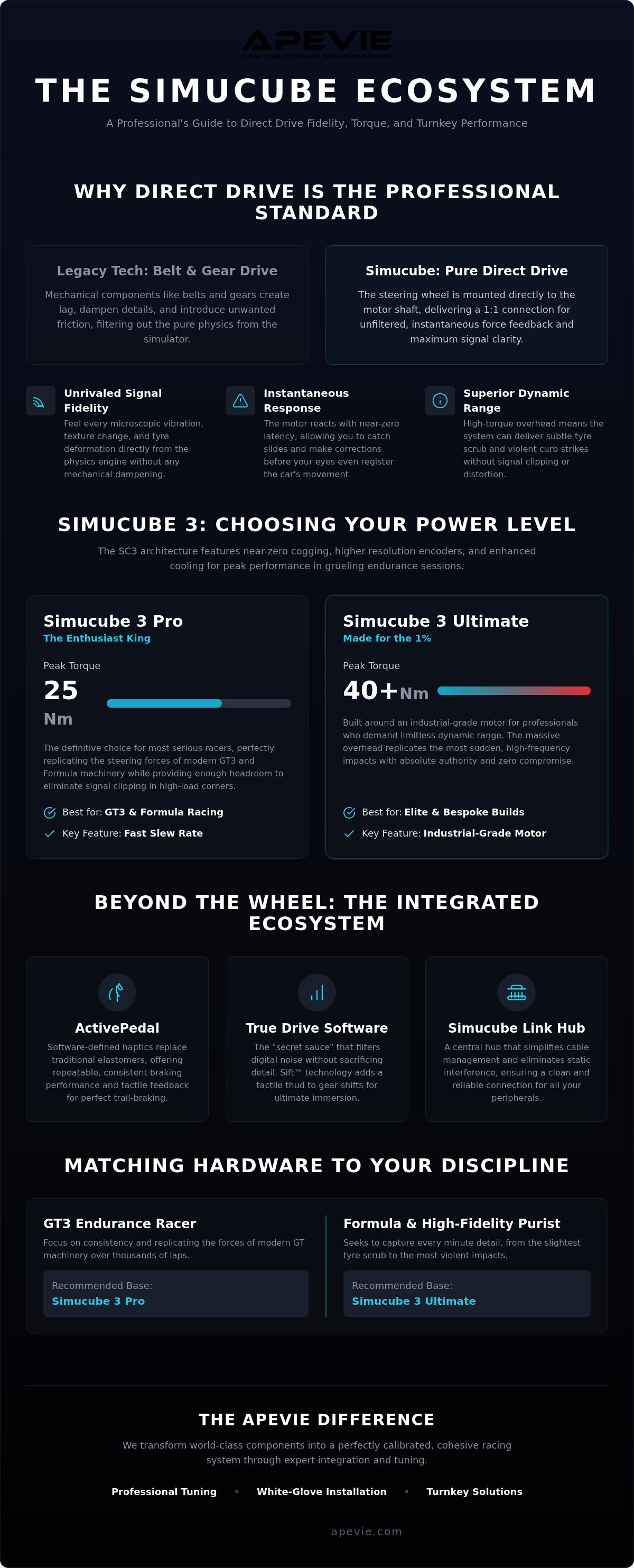
Direct drive technology connects the steering wheel directly to the motor's drive shaft, which eliminates the belts, gears, and mechanical interference that often dampen signal clarity in lesser systems. This 1:1 connection is why Direct Drive is the Professional Standard for drivers serious about shaving tenths off their lap times. While entry level units have become more common, the simucube ecosystem remains the benchmark for those who prioritize the purity of the driving sensation over marketing gimmicks.
Choosing a high end wheelbase isn't just about chasing the highest torque figures. While a massive motor provides the overhead needed to avoid signal clipping, it's the fidelity of that force feedback that matters most. These high performance systems excel at translating the microscopic vibrations of a car's suspension and the subtle scrub of front tires into tactile information. This level of detail allows you to react to a slide before your eyes even register the movement on screen, creating a more intuitive and natural connection to the virtual asphalt.
Software is the Secret Sauce: Simucube True Drive
The hardware is only half the story. The simucube True Drive software acts as a sophisticated filter that removes digital noise without sacrificing the raw detail coming from the simulator's physics engine. One of its standout features is Sift technology, which adds a mechanical, tactile thud to gear shifts that mimics the engagement of a real sequential gearbox. Whether you're navigating the laser scanned bumps of iRacing or the high speed kerbs in Assetto Corsa Competizione, you can swap between dedicated software profiles that optimize the motor's response for every specific discipline.
The PC-Only Advantage
To achieve the lightning fast response times required for professional simulation, this hardware focuses exclusively on the PC platform. Console hardware often imposes strict limitations on data refresh rates and telemetry bandwidth, which would essentially choke a high performance motor. By staying on PC, these systems can utilize high bandwidth telemetry to deliver a level of nuance that console compatible gear simply can't match. If you're planning a professional foundation for your setup, starting with a PC based architecture ensures your hardware isn't held back by simplified signal processing.
Simucube 3 vs. Simucube 2: Choosing Your Power Level
While the Simucube 2 series remains a capable option for many, the Simucube 3 lineup represents a fundamental shift in motor architecture and signal processing. The newer generation focuses on minimizing cogging torque to almost imperceptible levels while introducing higher encoder resolutions that capture even the smallest steering inputs. These technical refinements ensure that the transition from static friction to kinetic movement feels as fluid as a real steering rack, providing a level of natural feedback that wasn't possible in previous generations. The chassis also features enhanced cooling fins, allowing the internal components to maintain peak performance during grueling endurance sessions without thermal throttling.
Simucube 3 Ultimate: Made for the 1%
The Simucube 3 Ultimate is built around an industrial-grade motor designed to deliver over 40Nm of peak torque. You might wonder why anyone needs that much strength when most GT3 cars require significantly less force. The answer lies in dynamic range and slew rate. By having a massive amount of overhead, the motor can replicate sudden, high-frequency impacts without breaking a sweat. This headroom ensures that the simucube system never has to "soften" the signal to protect the hardware. For those building a bespoke simulator, Apevie Simulators offers the Simucube 3 Ultimate as the centerpiece of their most elite configurations.
Simucube 3 Pro: The Enthusiast King
For most high-end racers, the Simucube 3 Pro is the definitive choice. Delivering 25Nm of torque, it perfectly replicates the steering weight of modern GT3 and Formula machinery without the extreme physical demands of the Ultimate model. The 25Nm output provides enough torque headroom to prevent "clipping," a phenomenon where the motor reaches its maximum force and loses the ability to communicate subtle details during high-load corners. This ensures you still feel the vibrations of a rumble strip even when the steering is heavily loaded in a high-speed sweeper. Compared to the Sport model, the Pro offers a faster slew rate, meaning the motor reacts more quickly to rapid changes in the car's physics.
The Simucube 3 Sport serves as the entry point into this elite tier. It utilizes the same refined encoder technology as its larger siblings but in a more compact form factor. If you're coming from a belt-driven system or an entry-level direct drive unit, the jump in clarity is immediately apparent. You can explore our full range of simucube wheelbases to find the perfect balance of power and fidelity for your home rig.
Expanding the Rig: ActivePedals and One Link Integration
Building a professional simulator requires more than just a high-fidelity wheelbase. The pedals are your primary interface for weight transfer and braking consistency. The simucube ActivePedal represents a total departure from traditional hardware by replacing physical springs and elastomers with a software-defined actuator. This technology allows you to change the entire physical profile of your brake or throttle in seconds without ever picking up a wrench. Whether you want the rock-hard feel of a modern Formula car or the long, progressive travel of a vintage GT, it is all handled through the Simucube Tuner software.
ActivePedal Pro: Telemetry You Can Feel
The ActivePedal Pro serves as an incredible tool for developing muscle memory. Unlike passive load-cell pedals, this system uses telemetry data to send real-time vibrations directly to your foot. You will feel the distinct chatter of the ABS engaging or the subtle pulse of traction control as you exit a corner. This immediate feedback loop allows you to find the limit of grip faster than relying on visual cues alone. You can even customize the "bite point" of a clutch or the preload of a brake pedal with surgical precision. If you are curious about how these compare to traditional high-end mechanical options, our Guide to Sim Racing Pedals breaks down the engineering differences in detail.
While the Pro model is sufficient for most enthusiasts, the ActivePedal Ultimate offers higher peak force limits and even faster response times for elite drivers who require the absolute maximum resistance. At Apevie Simulators, we often integrate these with Heusinkveld Sim Pedals Ultimate+ units for a hybrid setup. This configuration balances the haptic braking of the ActivePedal with the familiar mechanical take-up of a traditional throttle, providing a tailored experience that fits your specific driving style.
The One Link Hub Advantage
As you add more components to a rig, cable management becomes a significant hurdle. The simucube One Link Hub solves this by acting as a centralized connectivity point. Instead of running multiple USB cables back to your PC, the Link hub allows for a single-cable connection for the entire ecosystem. This does more than just clean up the "cable nest" on your aluminum extrusion rig. It significantly reduces the risk of Electromagnetic Interference (EMI), which can cause ghost inputs or signal dropouts in high-torque setups. By isolating the data signals, the Link hub ensures that your steering and pedal inputs remain pure and uninterrupted during long competition stints.
Buyer Decision Framework: Matching Hardware to Discipline
Selecting your simucube base shouldn't be a game of "highest number wins." The car classes you frequent dictate the motor response you need. For GT3 and endurance racing, the Simucube 3 Pro is often the superior choice. Long stints require a balance between physical feedback and driver fatigue. Real GT3 machinery often operates with steering rack forces between 10Nm and 15Nm. With 25Nm of peak torque, the Pro model provides the full dynamic range of a modern GT car without the brutal physical toll that an industrial-grade motor can exert over a three-hour session.
Formula and open-wheel enthusiasts require something different. These cars have incredibly high downforce and heavy steering racks that translate every ripple in the track directly to the driver. The Simucube 3 Ultimate excels here because its high slew rate allows it to replicate the violent, instantaneous snaps of a car losing grip at 200 mph. It's about how fast the motor can change direction, not just how hard it can pull. If you're drifting or rally racing, you'll value steering speed and recovery torque above all else. You need a motor that can spin freely and return to center with enough force to mimic a front-wheel-drive self-centering effect or a high-angle drift recovery during a flick.
Rig Rigidity: Can Your Chassis Handle 40Nm?
A common mistake is buying more torque than your chassis can handle without flexing. Any movement in your wheel deck or pedal plate acts like a sponge, absorbing the fine vibrations and haptic details you paid for. For any simucube 3 system, a heavy-duty 80/20 aluminum extrusion rig is mandatory. This becomes even more critical when integrating motion. Systems like the Sigma Integrale DK2 Motion Systems require a rock-solid foundation to ensure the haptic feedback from the wheel and the physical pitch of the rig work in harmony rather than fighting each other. If your rig wobbles, you're losing the competitive edge that direct drive provides.
Steering Wheel Compatibility
Your choice of steering wheel completes the tactile experience. High-end rims from Gomez Sim Industries (GSI) or Cube Controls are designed to handle the high rotational forces of direct drive motors without creaking or flexing. While the Simucube Wireless Wheel ecosystem offers a clean look, many professional racers still prefer wired USB options for the absolute lowest latency and the ability to run complex dash displays on the wheel itself. Choosing the right rim ensures that the motor's fidelity isn't lost in a cheap, flexible steering wheel. If you're unsure which combination fits your racing style, you can consult with our experts at Apevie Simulators for a tailored hardware recommendation.
The Apevie Difference: Turnkey Simucube Solutions
Investing in a simucube wheelbase is a significant commitment to your racing performance, but unboxing the hardware is only half the battle. Many racers find themselves lost in the technical weeds of software filters, damping settings, and friction levels. Without professional calibration, even the most expensive industrial motor can feel robotic or disconnected. We believe that buying a box is just the beginning. The true value lies in the expert tuning that transforms raw torque into a natural, transparent communication between the car's tires and your hands.
Apevie Simulators specializes in bespoke component matching. We don't just sell parts; we curate ecosystems where a Gomez Sim Industries (GSI) wheel and a Simucube 3 base work in perfect harmony. This involves more than just bolting pieces together. It requires a deep understanding of how different steering rims affect the rotational inertia and felt fidelity of the motor. Our goal is to ensure that the hardware disappears, leaving you with nothing but the pure sensation of the track.
Custom Builds and Expert Consultation
Our consultation process is designed to remove the anxiety of choice. We help you determine if the high slew rate of the Ultimate model is necessary for your open-wheel aspirations or if the Pro model offers the ideal balance for your GT3 endurance rig. This expertise extends to the wider cockpit environment, including the seamless integration with advanced Haptic Systems. By aligning the haptic feedback of your pedals and seat with the steering signals, we create a unified digital nervous system for your simulator.
Turnkey Ready-to-Race Packages
Professional simulation gear is heavy, complex, and sensitive to electrical interference. Shipping a crate to your door is one thing. Having a technician arrive at your home to assemble, wire, and calibrate that system is what separates a gaming setup from a professional training tool. Our white-glove installation service is available nationally, ensuring your rig is rigid, grounded, and updated to the latest simucube firmware before you ever turn a lap.
We provide ongoing post-installation support to keep your system performing at its peak. As simulation software evolves, we help you navigate the updates to ensure your profiles remain optimized for the latest physics engines. If you're ready to move beyond the frustration of DIY troubleshooting and step into a professional-grade environment, you can browse the full Simucube collection at Apevie Simulators. Let us handle the engineering so you can focus on the driving.
Mastering the Apex of Direct Drive Technology
The transition to a professional-grade simulator is a journey that requires technical precision and a clear understanding of your goals on the track. Whether you choose the balanced performance of the Simucube 3 Pro for endurance racing or the raw 40Nm overhead of the Ultimate for open-wheel fidelity, the hardware is only one piece of the puzzle. Integrating software-defined haptics through ActivePedals and organizing your rig with the One Link hub ensures that every signal is translated into meaningful telemetry.
As an authorized partner specializing in high-torque simucube systems, we understand that the ultimate setup requires more than just high-end parts. It demands expert white-glove installation and meticulous tuning to ensure your GSI wheel and motion platform function as a single, cohesive unit. This attention to detail is what allows the technology to fade into the background; it leaves you with an authentic, unfiltered connection to the car. If you're ready to build a rig that matches your competitive ambitions, our team is here to help you navigate every technical nuance.
Shop the Elite Simucube Collection at Apevie Simulators
We look forward to helping you master the limit of grip.
Frequently Asked Questions
What is the difference between Simucube 2 and Simucube 3?
The Simucube 3 series introduces a refined motor architecture that virtually eliminates cogging torque while significantly increasing encoder resolution. Unlike the previous generation, these newer models feature enhanced thermal management and support the One Link ecosystem. While Simucube 2 remains a solid choice, the third generation provides the necessary bandwidth for the latest high-fidelity telemetry found in modern simulators, ensuring a smoother and more detailed steering response.
Do I need a special mount for a Simucube 3 Ultimate?
Yes, the Simucube 3 Ultimate requires a high-strength mounting solution due to its weight and the 40Nm of peak torque it produces. Standard wheel decks found on entry-level cockpits will likely flex or fail under these loads. We recommend using a dedicated front-mount or side-mount bracket specifically designed for high-torque motors, securely fastened to a heavy-duty aluminum extrusion chassis to preserve signal clarity.
Can I use Fanatec wheels with a Simucube wheelbase?
You can use Fanatec steering wheels with a simucube base, but it requires a third-party conversion kit to translate the proprietary connection to a standard USB signal. Once converted, you must also attach a Simucube Quick Release (SQR) to the wheel. This allows you to enjoy the ergonomics of Fanatec rims while benefiting from the superior force feedback of a professional direct drive motor.
Is 25Nm of torque too much for a home sim rig?
Having 25Nm of torque isn't about the physical effort required to turn the wheel; it's about providing enough dynamic headroom to prevent signal clipping. If you use a lower-torque motor, the feedback often hits a ceiling during high-load corners, which hides subtle details like kerb strikes. A 25Nm motor allows you to run realistic steering forces while still having plenty of room to communicate fine textures.
What are ActivePedals and are they worth the investment?
Simucube ActivePedals are software-defined haptic units that replace traditional springs and elastomers with a motorized actuator. They are worth the investment for drivers who want to feel ABS and traction control pulses directly through their feet. By using the Simucube Tuner software, you can change the entire physical feel of the pedal in seconds, which is impossible with standard mechanical pedal sets that require manual spring swaps.
How does Simucube compare to the Logitech G Pro or Fanatec DD2?
Simucube systems occupy a higher tier of professional hardware compared to the Logitech G Pro or the older Fanatec DD2. While those brands offer great entry points, they often prioritize console compatibility and simplified setups. Simucube focuses exclusively on PC performance, providing much higher signal fidelity, lower latency, and a more robust software ecosystem via True Drive, which is essential for serious competitive training.
Does Simucube work on PlayStation or Xbox?
No, Simucube hardware does not work natively on PlayStation or Xbox consoles. The high-bandwidth telemetry and complex signal processing required for these professional motors are only possible on a PC. Attempting to use adapters to force console compatibility often results in significant latency and a loss of the fine detail that makes these high-end direct drive systems valuable to professional drivers in the first place.
What is the One Link Hub and do I need it for my setup?
The One Link Hub is a centralized connectivity device that allows you to connect your wheelbase, pedals, and peripherals through a single cable to your PC. You don't strictly need it to operate a single wheelbase, but it becomes essential when building a full ecosystem with ActivePedals. It effectively reduces electromagnetic interference (EMI) and simplifies the cable management on your aluminum rig for a cleaner, more reliable professional setup.