The Best Direct Drive Wheelbase for Sim Racing in 2026: An Expert Buying Guide
That 30Nm wheelbase you're eyeing might actually be making you slower on the track. While the industry pushes for higher peak torque, the reality is that raw power often masks the subtle vibrations and tire slip data your brain needs to react instantly. If you're searching for the best direct drive wheelbase 2026 offers, you've likely realized that marketing specs don't always equate to on-track performance. It's a frustrating cycle of buying gear based on a number, only to find the steering feel muddy or disconnected during a 45-minute endurance stint.
We understand the anxiety of investing thousands into an ecosystem only to feel locked out of future innovations or high-end motion systems. You deserve a setup that balances raw strength with surgical precision. This guide cuts through the noise to help you identify the hardware that delivers genuine fidelity rather than just heavy resistance. We'll break down the latest offerings from brands like Simucube and Asetek, providing a clear roadmap to a future-proof rig. You'll gain the confidence to choose a wheelbase that integrates perfectly with professional-grade components, ensuring your investment remains relevant well into the next decade.
Key Takeaways
- Discover why 2026 technology prioritizes signal resolution and high-fidelity feedback over raw torque to deliver the granular detail required for professional-grade racing.
- Evaluate the Simucube 3 lineup against flagship alternatives from Fanatec and Moza to determine the best direct drive wheelbase 2026 for your specific performance requirements.
- Apply our expert decision framework to audit your chassis rigidity and ensure your mounting solution can handle the precision of a high-torque motor without flexing.
- Master the technical nuances of slew rate, damping, and inertia settings to eliminate feedback "mushiness" and achieve a sharp, authentic steering feel.
- Understand the Apevie advantage, where expert consultation and white-glove installation transform high-end components into a perfectly calibrated, turnkey racing experience.
Understanding Direct Drive: Why Fidelity Trumps Raw Torque in 2026
You are approaching the limit at the 130R corner at Suzuka, and your hands need to know exactly when the front tires begin to scrub. In the past, sim racers settled for belt-driven systems that dampened these vital vibrations. A Direct-drive mechanism eliminates those intermediaries by mounting the steering rim directly onto the motor shaft. This design ensures that every bit of data from the simulation reaches your palms without being filtered by mechanical friction. By 2026, the search for the best direct drive wheelbase 2026 has moved beyond a simple quest for power. It's now a pursuit of signal purity and surgical precision.
High-end racing isn't about wrestling a heavy wheel; it's about developing consistent muscle memory. When a motor provides a clean, linear response, your brain maps the car's behavior more effectively. This allows you to catch slides before they happen. Many enthusiasts mistakenly believe that more Newton-meters (Nm) automatically result in a better experience. In reality, a 30Nm base with poor signal processing will feel like a blunt instrument compared to a refined 15Nm unit. Apevie Simulators prioritizes this balance in every turnkey installation, ensuring the hardware translates physics into feeling with total transparency.
The Mechanics of Force Feedback Fidelity
The secret to modern performance lies in the encoder resolution. In 2026, premium bases utilize 22-bit or higher encoders, which provide over 4.1 million points of feedback per single revolution. This level of detail allows you to distinguish between different track surfaces, such as the transition from smooth asphalt to weathered concrete. Latency is the silent performance killer in many mid-range setups. If the communication between your PC and the motor exceeds a 1-millisecond delay, your reactions will always be behind the car. Systems from brands like Simucube or Asetek, which we often integrate into our bespoke builds, focus on minimizing this lag to provide an instantaneous connection.
Decoding Torque Ratings: Peak vs. Holding Torque
Understanding the difference between peak and holding torque is essential for any serious buyer. Peak torque refers to the momentary maximum force the motor can produce during an impact or a sharp curb strike. While these 20Nm or 25Nm bursts add immersion, they don't define the racing experience. Holding torque is the sustained force the motor maintains during long, high-speed corners. A common issue with lower-quality motors is thermal throttling. If a base lacks professional-grade cooling, it might lose 15% of its strength during a long session. For endurance racers, this fade is a dealbreaker. We recommend components from Precision Sim Engineering and other top-tier manufacturers that guarantee consistent performance from the first lap to the last. This reliability is why professional drivers trust Apevie Simulators for their home training environments.
Apevie Simulators offers white-glove installation and expert consultation to help you select the best direct drive wheelbase 2026 for your specific needs. Whether you are building a professional training rig or a high-end home simulator, our team ensures every component is optimized for peak performance. Contact us today for a professional consultation or to begin your custom simulator build.
Top Direct Drive Contenders: Simucube vs. The Field
Most drivers chase peak torque, but they often end up with "notchy" feedback or thermal throttling after thirty minutes of heavy racing. The best direct drive wheelbase 2026 market has moved beyond the simple arms race for Newton-meters. It's now a battle for signal purity and thermal stability. Simucube remains the professional benchmark, but the gap is closing as rivals refine their software ecosystems and hardware durability.
Simucube 3: The New Industry Benchmark
The Simucube 3 series redefined expectations for high-end simulators in early 2026. The Sport, Pro, and Ultimate models now feature advanced active cooling systems that prevent the subtle force-feedback fade seen in older motor designs. Their True Drive software provides a level of granular tuning that eliminates high-frequency electronic noise without masking the essential tire-slip data. While the Ultimate model offers overkill power for most, the Simucube 2 Pro continues to be the sweet spot for serious enthusiasts who demand industrial-grade reliability without the professional-team price tag.
High-Performance Alternatives: Beyond the Big Names
Fanatec's Podium line remains a strong choice for those already deep in their ecosystem, especially with their focus on seamless console compatibility. However, Moza has made massive strides in 2026, releasing software updates that significantly improve FFB algorithms to rival European manufacturers. For racers seeking the absolute peak of tactile feedback, boutique wheels from Precision Sim Engineering are the preferred choice. These high-end components rely on precision engineering to ensure every vibration from the virtual curb feels authentic and consistent across long sessions.
- Motor Grade: Simucube uses industrial motors designed for 24/7 operation, whereas many consumer brands use lighter-duty motors that can overheat during endurance events.
- Quick Release Systems: Proprietary systems often develop "play" or flex over time. Open-standard systems, like those used by Simucube, offer a rock-solid connection that feels like a real GT3 steering column.
- Signal Processing: Professional bases use higher-resolution encoders to translate game data into motion, resulting in a smoother feel rather than a "robotic" or stepped sensation.
Choosing between these contenders depends on your long-term goals. If you want a "set it and forget it" experience with massive community support, the established brands are safe. If you're building a professional-grade rig that requires zero compromise in fidelity, looking toward boutique setups is the right path. For those planning a complete system overhaul, consulting with the experts at Precision Sim Engineering can help you integrate these powerful bases into a cohesive, high-performance environment.
The Buyer’s Decision Framework: Matching Base to Rig
Selecting the best direct drive wheelbase 2026 isn't just about picking the motor with the highest peak torque. It's about balance. If you bolt a high-end 25Nm motor to a weak frame, you're essentially throwing away the fidelity you paid for. The wheelbase acts as the heart of your simulator, but its performance is strictly limited by the structural integrity of your cockpit and the quality of your peripherals.
Assessing Your Chassis Rigidity
A high-torque base on a lightweight or entry-level cockpit creates rig flex. This isn't just a minor annoyance; it's a mechanical filter that absorbs the subtle vibrations of a tire scrubbing the asphalt or a suspension bottoming out. When your wheelbase mount moves even 2 millimeters under load, that's detail you'll never feel in your hands. For professional applications in 2026, bottom-mounting is becoming obsolete for high-torque motors. Side-mounting or front-mounting directly to 15mm thick aluminum plates is the standard for stability. You can find deeper technical specs on structural integrity in The Ultimate Sim Rig Guide: Building a Professional Foundation in 2026.
Ecosystem and Peripheral Compatibility
Your wheelbase is the brain, but your steering wheel is the primary interface. High-end manufacturers like Gomez Sim Industries (GSI), Cube Controls, and Ascher Racing offer distinct tactile experiences that must be compatible with your base's quick-release system. If you're looking for a dedicated F1 steering wheel, check the mounting patterns and data connection types carefully. While wireless connectivity has improved significantly by 2026, many professional drivers still prefer the zero-latency reliability of a high-quality coiled USB cable. Integrating these with high-end pedals like Heusinkveld Ultimates ensures your control inputs match the precision of your force feedback.
To choose the right setup, follow this four-step audit to ensure your hardware works in harmony:
- Step 1: Audit Rigidity. Ensure your 80/20 aluminum profile or steel chassis can handle 20Nm+ without twisting. If the rig moves, the force feedback detail dies.
- Step 2: Define Your Discipline. GT3 racers need sustained, heavy torque for long corners. Rally drivers require lower peak forces but much faster rotation speeds for rapid counter-steering.
- Step 3: Choose Your Ecosystem. Decide if you want the plug-and-play simplicity of a single-brand ecosystem or the bespoke feel of mixing a Simucube base with a GSI wheel.
- Step 4: Plan for Motion. If you intend to add a system like Sigma Integrale later, your wheelbase mounting solution must be robust enough to handle the added G-forces of a moving platform.
Investing in the best direct drive wheelbase 2026 requires looking at your simulator as a complete vehicle rather than a collection of parts. A 15Nm base on a rock-solid rig will always outperform a 30Nm base on a flexing frame. Focus on the foundation first, then select the motor that fits your specific racing goals.
Technical Optimization: Beyond the Initial Setup
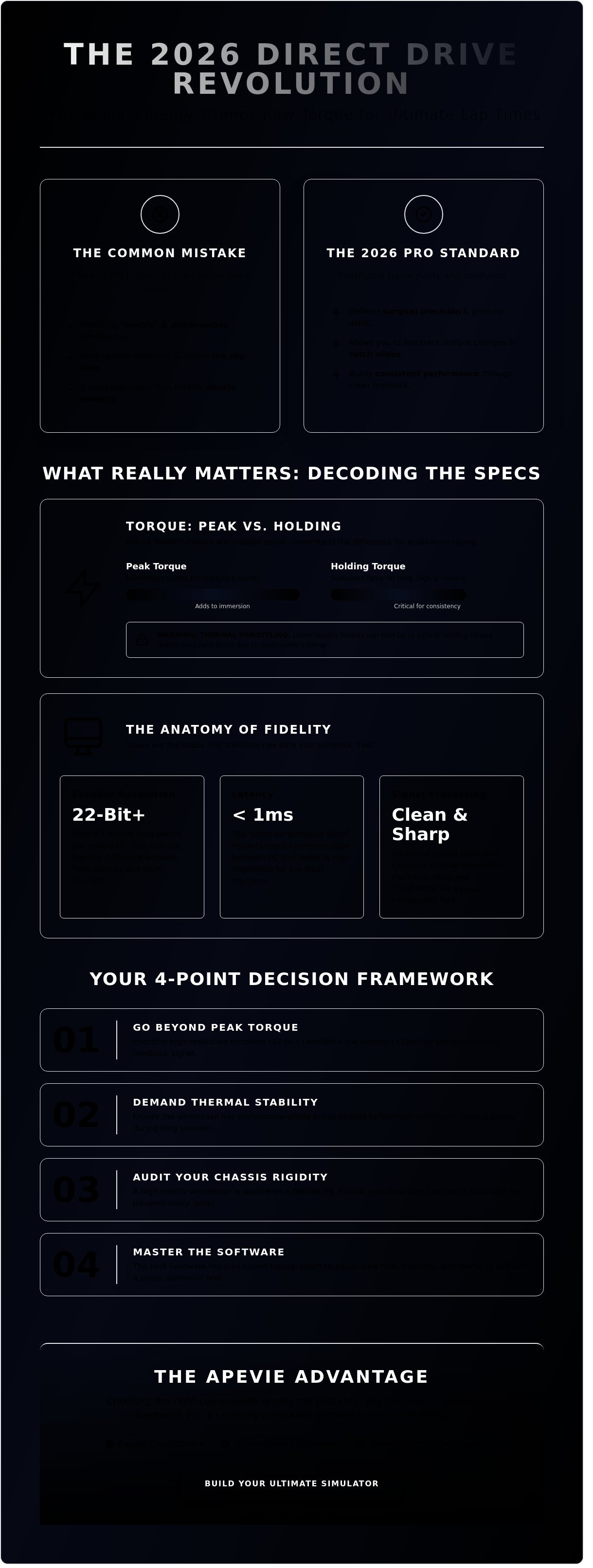
Buying the best direct drive wheelbase 2026 doesn't guarantee a perfect driving feel right out of the box. Many enthusiasts find that even the most expensive hardware can feel "mushy" or overly digital without proper calibration. True performance is found in the intersection of motor physics and signal processing. While a motor might be capable of 25 Nm of torque, it's the speed and clarity of that delivery that determines whether you can actually feel the front tires scrubbing in a long sweeper. High-end setups require a deep dive into the software layer to translate raw data into tactile intuition.
Slew Rate and Signal Processing
Slew rate measures how fast the motor changes its torque output, typically expressed in Newton-meters per millisecond (Nm/ms). In the 2026 market, top-tier bases like the Simucube 2 Pro offer slew rates around 3.2 Nm/ms. This metric is vital for catching slides. When the rear of the car steps out, the steering rack reacts instantly. If your slew rate is too low, the feedback feels rounded off and slow. You'll find yourself reacting to the visual cues on screen rather than the physical cues in your hands. However, running maximum slew rates can lead to violent oscillations on the straights. You must balance the "bite" of the motor with enough smoothing to keep the rig controllable during high-speed runs.
Software Ecosystems: True Drive vs. The Rest
By 2026, software has become the primary differentiator between hardware brands. Simucube’s True Drive remains the benchmark because it allows for granular control over reconstruction filters, damping, and friction. Modern updates have introduced AI-driven FFB smoothing. These algorithms analyze the game's telemetry 1,000 times per second to remove digital "graininess" without adding perceptible latency. Cloud-based profiles are now a standard requirement for serious racers. Instead of spending hours testing, you can download a profile tuned by a professional driver for a specific car in Assetto Corsa Competizione. This ensures the inertia and friction settings perfectly mimic the weight of a real GT3 steering rack.
Don't overlook the importance of electrical hygiene. High-torque motors generate significant Electromagnetic Interference (EMI), which often causes ghost inputs or flickering monitors. Professional builds utilize dual power supplies and shielded cables to isolate these signals. When we design turnkey systems, we prioritize this level of technical detail to ensure the hardware performs at its peak potential. If you want a system that is professionally calibrated and shielded for maximum performance, consider our custom simulator build services for a seamless experience.
Tuning requirements vary significantly between racing titles. iRacing provides a raw, linear signal that requires very little internal damping from the wheelbase software. In contrast, titles like ACC or the latest Rennsport builds have complex internal suspension models. These often require higher friction and inertia settings to prevent the wheel from feeling too light or twitchy. Understanding these differences allows you to maintain a consistent "muscle memory" across every platform you race on.
The Apevie Advantage: Turnkey Integration and Professional Support
Selecting the best direct drive wheelbase 2026 represents only half the journey toward a professional-grade simulation experience. Many enthusiasts spend thousands on high-torque hardware only to mount it on a flex-heavy chassis or a poorly braced aluminum profile rig. Apevie understands that hardware is a tool, not a solution on its own. True immersion comes from the synergy between your wheelbase, your chassis, and your motion system. We focus on turnkey integration so you don't spend your weekends troubleshooting driver conflicts instead of hitting apexes.
Professional consultation is the most effective way to avoid the common "buy twice, cry twice" trap. It's easy to overspend on a motor while neglecting the pedals or the seat, leading to a mismatched system that limits your performance. Our team evaluates your specific goals, whether you're a professional driver training for a GT3 season or a dedicated hobbyist seeking the ultimate home setup. By balancing Simucube power with Sigma Integrale motion systems, we create a cohesive environment where every vibration serves a purpose.
Why White-Glove Installation Matters
High-torque motors generate significant electromagnetic interference (EMI). This often causes ghost inputs in shifters or flickering in high-refresh-rate monitors. Our white-glove installation service for national customers includes specialized shielding and meticulous cable routing to eliminate these technical artifacts. We also handle the physics of the cockpit. A modern 1000R curved monitor requires precise mathematical alignment with your seating position to ensure your Field of View (FOV) is 1:1 with the virtual world. Apevie technicians test every rig for at least 48 hours before delivery, ensuring the force feedback profiles are perfectly calibrated for the specific torque curves of your motor.
Building a Future-Proof Simulator
We select components that will remain industry standards through the 2030s. This means pairing your best direct drive wheelbase 2026 choice with components like Simucube pedals for a unified software experience. Having a single interface for your primary control inputs reduces latency and simplifies calibration. When you combine the raw data from the wheelbase with the subtle haptics of a Sigma Integrale motion platform, the simulator stops feeling like a peripheral and starts feeling like a vehicle.
Apevie Simulator provides the expertise needed to turn a collection of parts into a precision instrument. If you're ready to invest in a simulator that delivers consistent performance without the headache of DIY troubleshooting, contact our team for a professional consultation. We'll help you design a build that meets your needs today and remains competitive for the decade to come.
Secure Your Competitive Edge on the Track
Identifying the best direct drive wheelbase 2026 requires looking beyond peak torque figures to find the nuanced feedback that translates into faster lap times. By 2026, the industry has shifted toward high-frequency signal processing and seamless software ecosystems. Whether you choose the surgical precision of a Simucube 2 Pro or the integrated ecosystem of a high-end rival, your wheelbase is the foundation of your performance. A mismatched rig or poor calibration will mask the potential of even the most expensive hardware. It's about finding the balance between raw power and the digital fidelity that lets you feel the limit of traction.
You don't have to navigate these technical complexities alone. As an authorized Simucube dealer, Apevie provides more than just components. We specialize in custom high-performance turnkey builds and expert national white-glove installation to ensure every setting is optimized for your specific driving style. Skip the trial and error of DIY setups and start with a professional-grade environment designed for longevity and performance. Build your professional simulator with Apevie and experience the difference that expert integration makes. We're ready to help you cross the finish line first.
Frequently Asked Questions
Is 25Nm of torque dangerous for home sim racing?
25Nm of torque can cause physical injury, such as wrist sprains or thumb fractures, if you're caught off guard by a high-speed collision. Most modern units in 2026 include emergency stop buttons and software-based safety limits to mitigate these risks. We recommend setting your force feedback to 60% of the maximum capacity for daily sessions. This headroom ensures the motor operates within its linear range without clipping.
Can I use a Direct Drive wheelbase with a desk mount?
You can use entry-level units under 10Nm on a desk, but anything higher requires a dedicated aluminum profile cockpit. Standard office desks, typically made of 18mm particle board, cannot withstand the constant vibrations and 20Nm peak forces of the best direct drive wheelbase 2026 models. Apevie Simulator specializes in turnkey builds using 160mm aluminum profiles to ensure zero flex during high-torque maneuvers.
What is the difference between Simucube Sport and Pro in 2026?
The primary difference between the Simucube 2 Sport and Pro models involves peak torque and slew rate. The Sport offers 17Nm of torque, while the Pro provides 25Nm, allowing for more dynamic range before the signal clips. In 2026, the Pro remains the industry standard for serious enthusiasts who want the most detailed road texture. The Sport is a capable alternative for those using lighter 280mm steering wheels.
Do I need a specific PC to run a high-end Direct Drive base?
A high-end wheelbase doesn't require a specialized PC, but your computer must handle the telemetry data refresh rates of 1000Hz or higher. Most modern systems with an i7 processor and 16GB of RAM manage these background tasks easily. The real demand comes from the simulation software itself. If you're running iRacing or Assetto Corsa Competizione at 4K, focus on your GPU performance rather than the wheelbase software.
Will a Direct Drive base make me faster in iRacing?
A direct drive base won't instantly shave two seconds off your lap times, but it'll improve your consistency over a 40-minute race. The increased fidelity allows you to feel the car's limit more clearly, helping you catch oversteer before it ends your session. Data from professional sim leagues shows that the best direct drive wheelbase 2026 options provide the subtle cues needed to optimize trail braking and corner exits.
How do I prevent Electromagnetic Interference (EMI) with my DD base?
You can prevent Electromagnetic Interference by using shielded cables and ensuring your entire simulator rig is properly grounded. High-torque motors generate significant electrical noise that can interfere with USB peripherals or screen signals. We recommend installing 5mm ferrite cores on all data cables and plugging your wheelbase into a dedicated surge protector. Apevie’s professional installations include custom cable management to isolate power lines from data streams.
Are wireless steering wheels as reliable as wired ones for DD bases?
Wireless steering wheels are now 99.8% as reliable as wired versions thanks to low-latency protocols like Simucube Wireless or proprietary chips. You eliminate the risk of cable snagging during a 900-degree rotation, which is a common failure point in endurance racing. While wired connections still offer a psychological advantage for zero-latency purists, most racers won't notice the 2ms difference in signal transmission during a typical race session.
Is it worth upgrading from a Simucube 2 to a Simucube 3?
Upgrading to a Simucube 3 is worth the investment if you prioritize the new 360Hz feedback frequency and integrated active cooling. The SC3 hardware eliminates thermal throttling during 24-hour endurance events, maintaining consistent torque output from start to finish. If you're currently using a Simucube 2 Pro and only race 20-minute sprints, the performance gains might feel marginal. For professional setups, the 20% increase in data processing speed is a clear advantage.