The Professional Guide to Turnkey Simulators: Elite Performance in 2026
You might assume that buying the most expensive direct drive wheel and hydraulic pedals automatically guarantees a podium finish, but the reality is often a tangled mess of driver conflicts and calibration headaches. Spending weeks troubleshooting software instead of hitting the apex isn't why you invested in high-end gear. We understand that for a serious racer, the true value lies in how these components communicate with each other to replicate real-world physics. A professional turnkey simulator removes the barrier between you and the track by treating the rig as a single, cohesive instrument rather than a collection of disconnected parts.
This guide explores why an integrated ecosystem is the definitive choice for those who demand elite performance without the technical burden. You'll learn how a turnkey simulator utilizing the Simucube 3 wheel base and Sigma Integrale DK2 motion systems creates a synergy that off-the-shelf setups can't match. We'll examine the benefits of white-glove installation, the precision of professional calibration, and how expert support ensures your focus remains entirely on your lap times. Discover why investing in a pre-engineered solution from Apevie Simulator is the most direct path to a professional-grade racing experience.
Key Takeaways
- Understand how a professional turnkey simulator transforms a collection of high-end parts into a precision motorsport tool that is ready to run from day one.
- Learn why the Simucube 3 wheel base and Gomez Sim Industries steering wheels have become the 2026 benchmark for driver feedback and ergonomic accuracy.
- Discover the mechanical differences between Sigma Integrale DK2 and DK2+ motion systems and how they translate tire slip and weight transfer into actionable haptic data.
- Evaluate the true cost of DIY builds versus turnkey solutions by accounting for calibration time, component compatibility, and professional technical support.
- Explore the white-glove assembly process that integrates Heusinkveld pedals and custom aluminum rigs into a seamless, high-performance racing environment.
What is a Turnkey Simulator? Beyond the Gaming Setup
A professional turnkey simulator is far more than a simple bundle of high-end parts. It represents a fully integrated, motorsport-grade environment that arrives at your door completely assembled, calibrated, and ready for competition. While the market once focused on arcade-style entertainment, the landscape in 2026 has shifted toward professional driver development. Today, the hardware is so powerful and the software so complex that achieving true realism requires a level of professional integration that goes beyond what most enthusiasts can manage in a home garage.
The core difference between a DIY project and a professional build is engineering synergy. In a standard setup, you might have a top-tier wheel base and a sturdy seat, but they often function as isolated peripherals. A turnkey solution treats the rig as a single instrument. Every component is selected and tuned to ensure that the data coming from the simulation software reaches your hands and feet without distortion or lag. This level of precision is why professional teams rely on a full motion racing simulator to prepare for real-world events.
Engineering Synergy: The Heart of Turnkey
Torque and rigidity must live in perfect balance. If you mount a high-torque motor like the Simucube 3 to a frame that isn't reinforced, the chassis will flex, absorbing the fine vibrations you need to feel. A professional build utilizes a heavy-duty Aluminum Extrusion Sim Rig designed to handle extreme forces without a millimeter of movement. This ensures that every bit of force feedback is transmitted directly to the driver.
Software optimization is equally critical. Out-of-the-box settings for most direct drive systems are designed for safety and broad compatibility, which often results in "muffled" feedback. We spend hours fine-tuning signal filters to expose the subtle haptic details of tire scrub and track surface changes. We also prioritize EMI (Electromagnetic Interference) management. High-performance motors generate significant electrical noise that can cause ghost shifts or software crashes if the rig isn't properly grounded and shielded with professional-grade cabling.
Who Needs a Professional Turnkey Solution?
- Real-World Racers: Drivers who need to maintain muscle memory and learn track layouts without the massive costs of track days and fuel.
- High-Performance Enthusiasts: Individuals who want the absolute best fidelity and value their time too much to spend it troubleshooting driver conflicts or loose bolts.
- Corporate Clients: Businesses that require a reliable, high-impact activation tool for events where downtime isn't an option.
Choosing a turnkey simulator means you're investing in uptime and accuracy. It's the difference between being a mechanic and being a driver. When the system is engineered by experts, you can focus entirely on your racing line rather than your hardware settings. This level of professional-grade reliability is also essential in command centers, where teams often explore Video Wall Systems from Activu Corporation to manage mission-critical operations.
The Anatomy of an Elite Turnkey Simulator Build
An elite turnkey simulator is only as good as its weakest link. In 2026, the standard for professional setups has moved far beyond consumer-grade plastic and belt-driven motors. High-level research facilities, such as those utilizing the National Advanced Driving Simulator, prove that fidelity is rooted in the precision of data transmission. For a home or corporate build, this means selecting components that don't just "feel" good but accurately replicate the mechanical resistance of a real race car. Each part must be chosen for its ability to work within a synchronized ecosystem.
Direct Drive and Steering Fidelity
The Simucube 3 wheel base is the undisputed benchmark for 2026 builds. It provides the massive torque headroom needed to simulate the heavy steering of a GT3 car or the violent, high-frequency snap of a Formula car without signal clipping. This motor doesn't just turn; it communicates. When we pair this base with a Gomez Sim Industries (GSI) Formula Pro Elite, you get a steering solution that integrates live telemetry data directly into the wheel's high-resolution display. For drivers who prioritize a more compact, ultra-reliable interface, the Cube Controls F-Core offers professional-grade rotary encoders and carbon fiber shifters that withstand thousands of hours of intense competition.
Stopping power is just as vital as steering. We consider load cell or hydraulic systems non-negotiable for serious performance. The Heusinkveld Sim Pedals Ultimate+ allow for precise pressure modulation, which is essential for consistent trail braking and muscle memory development. If you want to dive deeper into the engineering behind these inputs, explore The Ultimate Guide to Sim Racing Pedals.
The Foundation: Aluminum Extrusion and Rigidity
Everything rests on the chassis. A professional turnkey simulator must use a heavy-duty Aluminum Extrusion Sim Rig. If your wheel base outputs 25Nm of torque, a weak frame will flex, diluting the feedback and causing "vague" steering. Our builds utilize custom mounting plates and reinforced joints to ensure zero movement between the motor and the seat. This rigid foundation allows the motion system to work effectively without the frame absorbing the energy meant for the driver. You can learn more about choosing the right base in The Ultimate Sim Rig Guide.
If you're ready to see how these components work in harmony, explore our custom high-performance racing simulator options to find a setup tailored to your specific racing goals.
Motion and Haptics: The Final Frontier of Realism
Visual fidelity and steering torque provide the framework for a high-end experience, but motion and haptics provide the soul. In a professional turnkey simulator, the goal of a motion system is not to mimic a roller coaster; it is to provide the "seat-of-the-pants" feel that drivers rely on to sense the limits of grip. When you are traveling at 200 mph toward a heavy braking zone, your inner ear needs to feel the car pitch forward before your eyes even register the deceleration. This physical data loop allows for faster reactions and more consistent lap times.
High-performance builds prioritize subtle, high-frequency information over large, slow movements. By focusing on weight transfer and tire slip, a well-calibrated system tells you exactly when the rear tires are beginning to lose traction. If you want a deeper look at how these vibrations translate into driver confidence, read The Professional Guide to Haptic Systems.
Sigma Integrale: The Pro-Grade Motion Standard
The Sigma Integrale DK2 system has become the industry standard for elite builds due to its incredible response time and mechanical reliability. Drivers can choose between the DK2 system with 2-inch actuator travel or the DK2+ which offers 3-inch travel. While 2 inches is often sufficient for GT and Formula racing to simulate pitch and roll, the DK2+ provides the extra headroom needed for rally or tracks with extreme elevation changes like Spa-Francorchamps.
Latency is the enemy of immersion. If the rig moves even a few milliseconds after the car hits a curb, the brain perceives a disconnect that leads to motion sickness. Sigma Integrale utilizes proprietary low-latency software that integrates directly with PC-based simulations, ensuring that the physical movement is perfectly synchronized with the on-screen action. This level of integration is a hallmark of a high-end turnkey simulator where hardware and software are tuned to work as one.
Haptic Feedback vs. Kinetic Motion
It is important to distinguish between kinetic motion and haptic feedback. Kinetic motion involves moving the entire rig to simulate G-forces, surge, and sway. Haptics, on the other hand, involve high-frequency transducers that vibrate the chassis to simulate engine RPM, gear shifts, and ABS activation. While brands like Vesaro and SimCraft have set high benchmarks in the industry for motion fidelity, the most effective training tools use a hybrid approach.
- Kinetic Motion: Teaches you about weight transfer and chassis lean during cornering.
- Haptic Feedback: Provides "micro-data" like the vibration of a flat-spotted tire or the harshness of a rumble strip.
A professional turnkey build combines these two technologies to create a complete sensory profile. By layering haptic "noise" over smooth kinetic movements, the simulator provides the most accurate representation of a real race car's behavior. This dual-layer approach is what separates a professional development tool from a standard gaming setup.
Turnkey vs. DIY: Calculating the Real Cost of Performance
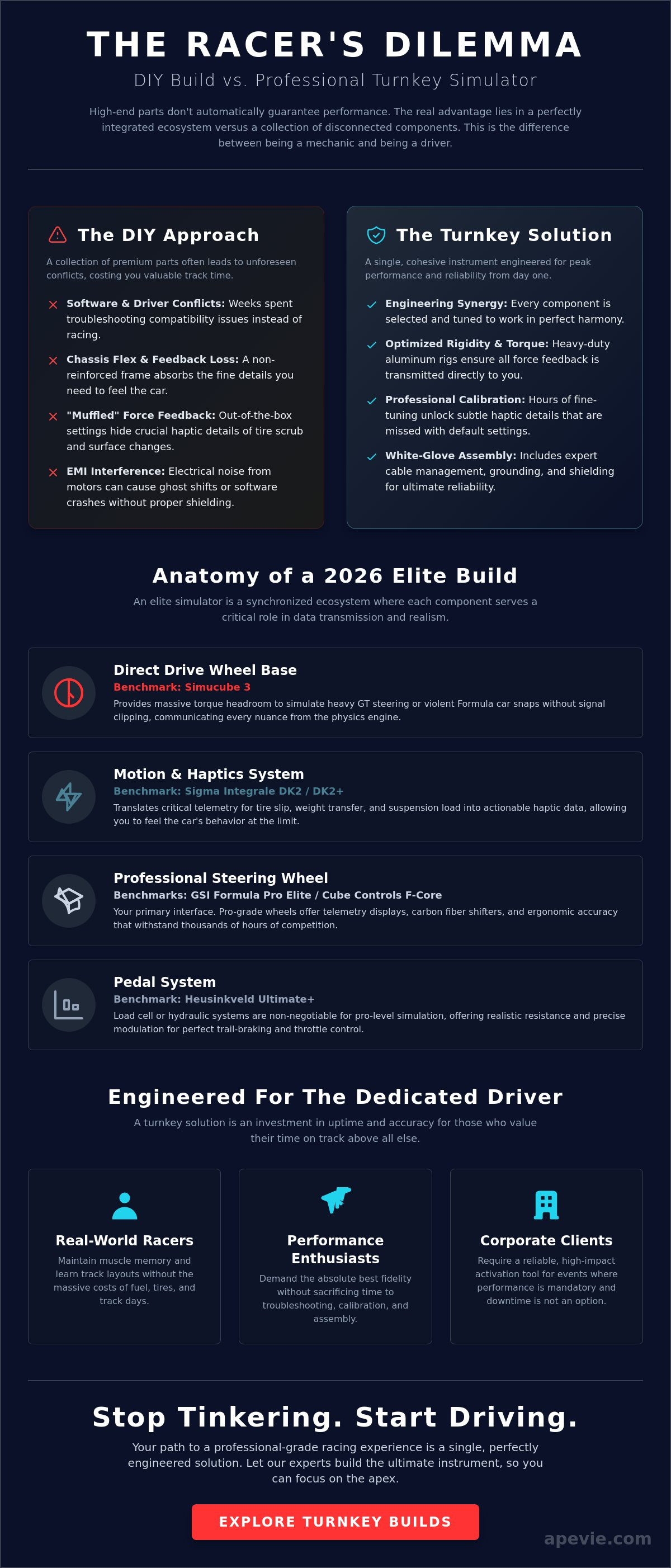
The allure of building a custom rig piece by piece is strong for those who enjoy the mechanical process, but the transition from a collection of parts to a high-fidelity racing tool is where most DIY projects stumble. A professional turnkey simulator isn't just about the convenience of assembly; it's about the hundreds of hours saved in troubleshooting and optimization. When you source components independently, you become your own lead engineer, IT support, and warranty coordinator. For many serious racers, the time spent in software menus is time stolen from the track.
Hidden costs often erode the perceived savings of a DIY build. Shipping multiple heavy crates from different international vendors, such as pedals from the Netherlands or a wheel base from Finland, quickly adds up. You also need a specialized toolkit, including high-torque hex sets and cable crimping equipment for proper EMI (Electromagnetic Interference) management. High-performance motors like the Simucube 3 generate significant electrical noise. Without professional-grade shielding and grounding, this noise can cause "ghosting" in your inputs or even crash your motion software mid-race.
- Choose DIY if: You have a deep background in PC architecture, enjoy spending weekends cable-managing, and view the build process as a primary hobby.
- Choose Turnkey if: You demand a "ready-to-run" system where every component is already optimized for maximum fidelity, backed by a single point of professional support.
TCO: Total Cost of Ownership Analysis
The resale value of a professionally branded turnkey simulator typically holds higher than a fragmented DIY setup. Buyers in the secondary market value the peace of mind that comes with a system engineered by specialists. Furthermore, turnkey packages often include pre-configured software licenses and professional tuning profiles that would cost thousands to replicate through private consultation. It's the difference between owning a kit car and a factory-tuned GT3 machine; one is a project, the other is a performance tool.
Professional Tuning: The Secret Sauce
Calibration is where the elite experience truly lives. We don't just install the drivers; we map custom force feedback curves tailored to specific vehicle classes. A GT3 car requires a different steering weight and damping profile than a high-downforce Formula 1 car. Our process involves aligning the physical motion of the Sigma Integrale DK2 actuators with the visual telemetry of the sim. This ensures that when you see a curb strike in iRacing or Assetto Corsa Competizione, your body feels it at the exact same millisecond.
If you prefer to focus on your racing line rather than your firmware versions, consider our turnkey racing simulator package for a seamless, professional-grade solution.
The Apevie White-Glove Experience: Your Turnkey Journey
Every elite racing journey begins with a precise understanding of the driver's objectives. We don't view a turnkey simulator as a standardized product, but as a bespoke instrument tailored to your specific biomechanical needs and competitive goals. The process starts with a deep-dive consultation where we map your racing ambitions to the correct hardware ecosystem. Whether you are a professional driver looking to shave tenths off a qualifying lap at Monza or an enthusiast seeking the most authentic home experience, the configuration must be intentional.
Once the blueprint is finalized, our engineers begin the meticulous assembly process. We integrate the high-performance components discussed in previous sections, such as Heusinkveld Sim Pedals Ultimate+ and Simucube 3 wheel bases, into a reinforced aluminum chassis. Every bolt is torqued to spec, and every cable is shielded to prevent the EMI issues that often plague DIY builds. This phase ensures that the mechanical foundation of your rig is as stable as a factory-prepped race car.
Customization: Tailoring the Rig to the Driver
The physical geometry of your simulator should mirror the cockpit you inhabit on the track. Drivers can choose between a GT Simulator Cockpit for endurance racing feel or an Open Wheel Simulator Cockpit for a reclined, Formula-style seating position. This ergonomic alignment is crucial for developing the correct muscle memory during long training sessions.
Visual immersion is another critical choice in the customization phase. We offer configurations ranging from immersive Triple Monitor Setups to Ultrawide Curved Monitor Setups, or even high-fidelity VR Headsets for sim racing. To complete the interface, you can select from world-class steering solutions by Precision Sim Engineering or high-resolution displays from Cube Controls. Each choice is integrated into the system's central control unit for a seamless user experience.
Support and Maintenance: Ensuring Peak Performance
The relationship doesn't end when the simulator is delivered. Our White Glove Simulator Installation Service includes national delivery and on-site training to ensure you understand every aspect of your new system. We walk you through the motion software, wheel base settings, and pedal calibration so you can start racing with confidence immediately.
Ongoing technical support is vital for maintaining the complex motion and haptic systems that define a professional rig. Apevie provides remote diagnostics and managed firmware updates to ensure your hardware remains at peak performance throughout the 2026 season. If a software conflict arises or you need a custom force feedback profile for a new car release, our experts are available to resolve the issue without you ever leaving the cockpit. This commitment to longevity and reliability is what makes a professional system a true investment in your racing career.
Ready to bridge the gap between virtual and reality? Explore Apevie’s Turnkey Racing Simulator Packages and discover the difference that professional engineering makes.
Master the Track with Professional Engineering
Investing in a professional turnkey simulator is a strategic choice for those who value precision over troubleshooting. We've seen that the true advantage lies in the engineering synergy between components like the Simucube 3 and Sigma Integrale motion systems. Professional calibration ensures that the haptic data you receive is accurate and consistent. It's about eliminating the electrical interference and software conflicts that often plague unshielded DIY setups.
As an authorized Simucube and Fanatec distributor, Apevie provides the white-glove national installation and expert performance tuning necessary to maintain elite standards. You're securing a platform that's designed to evolve with the 2026 racing season and beyond. You deserve a racing environment that's ready to perform as soon as you sit in the cockpit. Your focus belongs on the next corner, not a firmware update.
Build Your Custom Turnkey Simulator with Apevie Today
The gap between simulation and reality has never been smaller. It's time to take your place on the grid.
Frequently Asked Questions
What is included in a professional turnkey simulator package?
A comprehensive package includes a reinforced aluminum extrusion chassis, a direct drive wheel base like the Simucube 3, and high-fidelity pedals such as the Heusinkveld Ultimate+. You also receive a display system consisting of triple monitors or an ultrawide setup, a professional steering wheel from Gomez Sim Industries or Cube Controls, and a custom-built PC. Every turnkey simulator is pre-wired, shielded against interference, and calibrated with expert software profiles before delivery.
How much space do I need for a full-motion turnkey racing rig?
You should dedicate a clear area of at least 8 feet by 10 feet for a full-motion setup. While the physical footprint of the aluminum rig itself is roughly 3 feet wide by 6 feet long, motion systems like the Sigma Integrale DK2 require a safety clearance zone. This buffer prevents the rig from striking walls or furniture during extreme pitch, roll, and heave movements during high-speed cornering.
Can a turnkey simulator be used for flight simulation as well?
Yes, many of our high-end systems are designed with modularity to support multiple disciplines. Apevie offers a specialized Turnkey Flight Simulator Package that utilizes the same motion platform technology found in our racing rigs. By integrating a flight yoke or joystick and reconfiguring the software profiles, you can transition from GT3 racing to civil or military aviation simulation on a single, high-performance platform.
Do turnkey simulators work on consoles like PS5 or Xbox?
Professional turnkey systems are almost exclusively PC-based to leverage the high-frequency telemetry data required for motion and advanced haptics. While Apevie is a Fanatec Authorized Distributor and sells console-compatible wheel bases, the full integration of a turnkey simulator requires the processing power and software flexibility of a high-end PC. Consoles don't support the complex data streams needed for 6DOF motion or professional-grade pedal calibration.
How long does the installation process take for a turnkey system?
A standard on-site installation by our white-glove team typically takes between four and eight hours depending on the complexity of the motion system. This timeframe includes the physical assembly of the rig, the alignment of triple monitors or VR headsets, and the fine-tuning of the motion software. We also provide a hands-on orientation to ensure you're comfortable with the hardware and software settings before we leave your facility.
Is a motion system necessary for professional racing training?
While a static rig is useful, a motion system is highly recommended for drivers who need to sense weight transfer and tire slip. Kinetic feedback from actuators like the Sigma Integrale DK2 provides the physical data that helps you identify the limit of adhesion. Without motion, you rely purely on visual and auditory cues, which often leads to slower reaction times when the rear of the car begins to rotate.
What kind of PC specs are required for a high-end turnkey rig in 2026?
A 2026 turnkey simulator requires a high-performance PC equipped with at least an NVIDIA RTX 50-series GPU and a modern multi-core processor to handle triple 4K resolutions or high-refresh VR. You also need a minimum of 32GB of high-speed RAM and a dedicated SSD for simulation software. These specifications ensure that the physics engine and motion telemetry run without latency, which is vital for preventing motion sickness and maintaining immersion.
Does Apevie offer support if I encounter software issues after installation?
We provide comprehensive remote diagnostics and technical support for all our integrated builds. If you encounter a driver conflict or need help updating your motion profiles for a new car in iRacing or Assetto Corsa Competizione, our experts can log in remotely to resolve the issue. Our goal is to maximize your uptime so you can focus on your racing line rather than troubleshooting technical glitches.