


The Professional Sim Racing Rig: An Engineering Guide to High-Performance Chassis
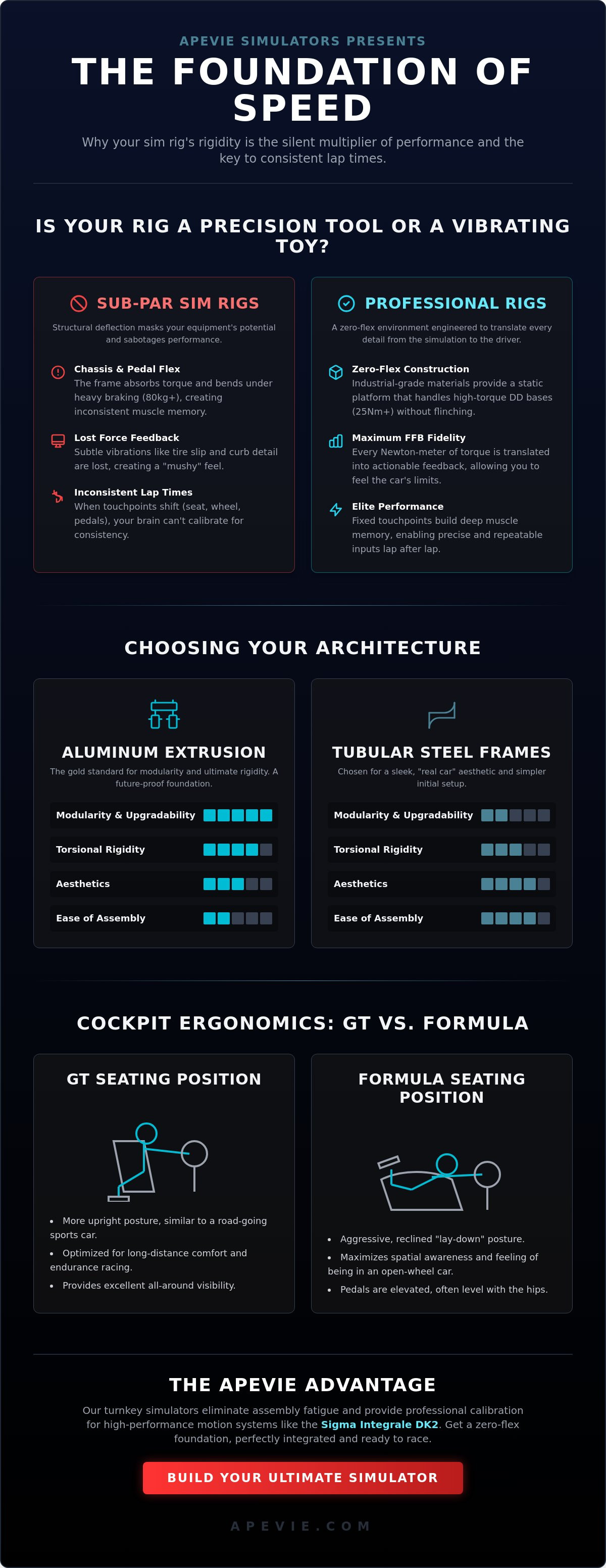
Your high-end direct drive wheel base is only as effective as the frame holding it in place. You might believe that inconsistent lap times are a result of poor focus, but the reality is often found in the structural deflection of a sub-par sim racing rig. When your pedal plate flexes under 80kg of load or your chassis absorbs the subtle vibrations from a 25Nm wheel base, you lose the tactile fidelity required for elite performance. It's a common frustration for serious racers who find their equipment's potential masked by an unstable foundation that wasn't built for high-torque loads.
We believe a professional simulator should be a precision tool, not a vibrating toy. This guide explores the engineering principles that eliminate mechanical noise and maximize force feedback detail. You'll learn how to select a foundation that handles professional-grade components without flinching. We'll also preview how Apevie Simulators designs cockpits that mimic authentic GT or Formula ergonomics while providing the structural integrity needed for advanced motion systems like the Sigma Integrale DK2.
Key Takeaways
- Understand why a professional sim racing rig must prioritize zero-flex construction to accurately translate every Newton-meter of torque from direct drive bases into actionable driver feedback.
- Compare the modular flexibility of aluminum extrusion chassis with the aesthetic appeal of tubular steel frames to determine which architecture best supports your long-term upgrade path.
- Discover how chassis rigidity acts as a silent performance multiplier by preventing the frame from absorbing micro-details like tire slip and curb vibrations.
- Learn the ergonomic differences between GT and Formula seating positions and how to optimize your cockpit for maximum spatial awareness and long-distance comfort.
- Explore the benefits of turnkey simulator packages that eliminate assembly fatigue and provide professional calibration for high-performance motion systems like the Sigma Integrale DK2.
What is a Professional Sim Racing Rig? Defining the Foundation
A professional sim racing rig isn't just a place to sit; it's a structural component of your racing system. To understand What is Sim Racing at the highest levels, you must view the chassis as the bridge between digital physics and human input. While entry-level setups focus on convenience, a professional foundation is engineered to be a zero-flex environment. When you use a high-torque direct drive base like the Fanatec Podium Wheel Base, any movement in the frame acts as a mechanical filter. At Apevie Simulators, we treat the chassis as the essential foundation for all high-performance hardware.
The rig serves a critical function by maintaining fixed distances between your primary touchpoints. In a real race car, the relationship between the seat, the wheel, and the pedals never changes. This stability is what allows drivers to develop the deep muscle memory required for consistent lap times. If your seat moves back even 2mm under heavy braking, your brain can't accurately calibrate the pressure needed for the next corner. A dedicated chassis ensures that every input you provide is translated directly into the simulation without being lost to structural deflection.
The Components of a Modern Racing Chassis
The main frame serves as the backbone of the system, handling massive longitudinal forces from heavy braking and lateral forces from high-speed steering. A professional wheel deck or front mount provides a rock-solid attachment point for the motor, ensuring that torque reaches your hands instead of shaking the entire rig. The pedal plate is equally vital. Professional load-cell pedals, such as the Heusinkveld Sim Pedals Ultimate+, require the driver to apply over 100kg of force. Without a rigid plate, this pressure causes the metal to bend, destroying the consistency needed for perfect trail braking.
Why "Gaming Chairs" Fail Professional Standards
Standard office or "gaming" chairs introduce variables that sabotage your performance. Swivel joints and casters mean your seating position shifts every time you hit the brakes, making it impossible to develop reliable muscle memory. Flex in a desk-mounted steering column creates a "mushy" feel where the force feedback loses its crispness. High-end builds, like those designed by Apevie Simulators or peers such as CXC Simulations, eliminate these inconsistencies by using industrial-grade materials that provide a truly static platform.
Aluminum Extrusion vs. Tubular Frames: Choosing Your Architecture
Selecting the structural architecture for your sim racing rig is the most consequential decision you'll make during a build. Most professionals choose between two distinct paths: modular aluminum extrusion, often called 80/20, or bespoke tubular steel frames. Both have their merits, but they serve different philosophies of simulator ownership. Aluminum extrusion is the industry standard for those who want a modular, future-proof foundation that grows with their hardware. Tubular frames, conversely, are often chosen for their aesthetic integration into high-end interiors or their resemblance to actual GT cockpits.
When comparing these architectures, consider the following decision framework:
- Modularity: Aluminum extrusion allows for infinite adjustment; tubular frames are often fixed or have limited sliding ranges.
- Rigidity: Heavy-duty aluminum profiles (40x120mm or 40x160mm) provide the highest torsional stiffness for 25Nm+ wheel bases.
- Aesthetics: Tubular frames offer a sleek, "real car" look, while extrusion has a more industrial, functional appearance.
- Installation: Extrusion requires significant assembly time; tubular frames often arrive partially welded or in fewer large pieces.
The 80/20 Advantage: Modularity and Rigidity
The primary draw of an aluminum profile rig is the T-slot system. These channels allow you to bolt on accessories like shifters, handbrakes, or triple monitor mounts at any point along the frame without drilling. You aren't locked into a manufacturer's specific mounting holes. A high-spec aluminum extrusion sim rig serves as the gold standard for professional duty because it allows for reinforcement where it's needed most. You can add extra corner brackets or cross-members to handle the massive longitudinal forces from high-end pedals. This architecture ensures that 100% of your physical input is captured by the sensors rather than being lost to frame flex.
Tubular Designs: Aesthetics vs. Practicality
If you want your simulator to look like it was pulled directly from a Porsche 911 GT3 R, a tubular frame is the answer. High-end bespoke builders like Vesaro or CXC Simulations excel at creating cohesive, beautiful designs that feel like real automotive cockpits. These rigs are excellent for turnkey solutions where the hardware is selected once and rarely changed. However, this beauty comes with a trade-off in flexibility. If you decide to upgrade to a new pedal set with a different bolt pattern, you might need to drill new holes or source a custom adapter plate. For many owners of Apevie Simulators, the choice between these styles depends on whether the rig will sit in a dedicated training room or a visible living space.
Rigidity isn't just about feel; it's about accurate data. Pro-level vehicle dynamics research shows that even minor chassis deflection can skew the feedback loop between the software and the driver. This is especially true when adding a motion system like the Sigma Integrale DK2. The extreme lateral and vertical forces generated by motion actuators require a chassis that won't twist under load. Aluminum extrusion is often the superior choice for motion because you can mount actuators directly to the main frame rails for a direct transfer of energy. If you're planning a build that scales with your skills, starting with a high-grade aluminum frame is the smartest move. You can explore our turnkey simulator packages to see how we integrate these modular frames into professional-grade setups at Apevie Simulators.
FFB Fidelity: Why Rigidity is the Silent Multiplier of Performance
Force feedback is more than just a motor pulling your hands; it's a complex stream of high-frequency data. If your sim racing rig isn't perfectly stiff, it acts as a mechanical damper, absorbing the micro-details that allow you to catch a slide before it happens. Research into the engineering of force feedback systems shows that any latency or attenuation in the signal path, including the chassis itself, degrades the driver's ability to react to simulation physics. A rigid rig ensures that 100% of the motor’s output reaches your fingertips without being filtered by structural movement.
Chassis resonance occurs when the structural frequency of the frame matches the motor's output, creating parasitic vibrations that blur the tactile signals needed for precise steering corrections. Professional drivers don't want a "lively" rig that shakes and rattles. They want a "dead" chassis that stays silent, allowing the wheel and pedals to communicate clearly. This stability is the difference between feeling a curb vibration and just feeling a generic rumble.
Matching Torque to Structural Integrity
High-end wheel bases like the Simucube 2 Pro or the Fanatec Podium series exert massive levels of torque that can twist a weak frame. A standard top-down wheel deck often flexes under these lateral loads, which is why we recommend a front-mount or side-mount solution. These mounts bolt directly to the vertical uprights of an aluminum profile rig, creating a shorter and stiffer path for the torque to travel. This configuration is essential for preserving the fidelity of high-end direct drive motors.
The same logic applies to your feet. You should see our Guide to Sim Racing Pedals to understand how pedal-rig synergy impacts consistency. If your pedal tray "lifts" or bows when you slam on 100kg of pressure with Heusinkveld Sim Pedals Ultimate+, you're losing the ability to modulate your braking precisely. Reinforcing the pedal deck with thick aluminum plates is non-negotiable for serious performance.
Eliminating the "Dead Zone" in Your Chassis
Common failure points often hide in plain sight. Steering uprights that aren't braced properly or pedal tray hinges made of thin steel are the usual suspects. These components create a "dead zone" where the first few degrees of steering or millimeters of braking are lost to frame movement. When this happens, you're essentially driving with a laggy interface. To prevent this, we use high-grade T-nut fasteners and heavy-duty gusseted corner brackets. These components lock the profiles together, turning several pieces of metal into a single, monolithic structure. Professional racers prioritize this weight and stability over a light frame because a heavy chassis provides the most stable platform for high-frequency tactile feedback.
Ergonomics and FOV: Optimizing Your Professional Cockpit
A professional sim racing rig serves as the cockpit's geometry controller, dictating how your body interacts with the physics of the drive. Your seating position isn't merely a matter of comfort; it defines your center of gravity and spatial awareness within the virtual 3D space. When your eyes are correctly aligned with the horizon of the screen and your limbs are at optimal reach, your brain processes the 1:1 scale of the simulation more naturally. This alignment is why choosing between a GT or Formula foundation is more than an aesthetic preference; it is a functional requirement for high-level performance.
GT vs. Formula Seating Geometry
GT racing usually demands an upright posture where your pedals are situated below or level with your hips. This configuration is preferred for long endurance sessions, as it reduces strain on the lower back and mirrors the ergonomics of a GT3 or touring car. Conversely, a Formula position requires a heavily reclined posture with your feet positioned above your hip line. This is essential for aero-focused immersion and high-downforce car control. High-end components from Precision Sim Engineering are designed specifically to complement these distinct hand positions, ensuring that shift paddles and encoders are exactly where your fingers expect them to be during high-G maneuvers.
Visual Immersion and Monitor Mounting
Visual fidelity depends on a mathematically correct Field of View (FOV). If your monitors sit on a standalone desk, the distance between your eyes and the glass can change every time you nudge the furniture or adjust your seat. This shift breaks the visual scaling of the world. Integrating triple monitors or a 49 inch ultrawide directly to the chassis ensures that this distance remains constant. This stability is vital when using motion systems that generate intense lateral forces.
Integrated mounts also allow you to bring the center screen closer to the wheel base, often positioning it just behind the steering rim. This proximity maximizes your peripheral vision and makes it easier to hit apexes consistently. For specific data on screen selection and placement, refer to our Racing Sim Monitor Guide. If you're struggling to calculate the perfect geometry for your space, our experts at Apevie Simulator provide professional consultation to ensure your cockpit is perfectly calibrated from day one.
Turnkey Simulators: The Ultimate Path to Professional Performance
Building a professional sim racing rig is a complex engineering project that often extends far beyond bolting aluminum profiles together. While the hardware components provide the foundation, the final stage of integration determines the difference between a collection of parts and a high-performance machine. This phase involves intricate software integration, haptic calibration, and meticulous cable management. For many serious enthusiasts, the primary hurdle isn't the cost, but the "assembly fatigue" that comes with troubleshooting driver conflicts or fine-tuning motion profiles for hours on end. Turnkey builds solve this by delivering a race-ready environment where every variable has been professionally addressed.
DIY vs. Professional Turnkey Builds
A DIY approach is often seen as a rite of passage, but it typically requires 20 or more hours of labor for assembly, wiring, and software configuration. Even after the physical build is complete, you're often left chasing "ghost" inputs or battling high-frequency interference in your USB chain. In contrast, a professional turnkey build offers immediate performance. At Apevie, we handle the complexities of high-bandwidth data routing and the specific driver needs of elite peripherals like Gomez Sim Industries (GSI) wheels or Simucube 3 bases. Our white-glove service includes professional cable management and software tuning, ensuring you spend your time on the track rather than under the desk with a hex key.
Future-Proofing Your Investment
A premium simulator foundation must support more than just your current hardware. It needs the structural integrity to handle future upgrades like active seat belts, wind simulation, or advanced haptic systems. We calibrate every axis of the Sigma Integrale DK2 or D-BOX motion systems to ensure the physical feedback is informative rather than just noisy. This professional calibration is essential for translating digital telemetry into realistic physical sensations that help you find the limit of grip.
Every turnkey package we design includes a high-performance PC foundation capable of driving triple 1440p or 4K monitors without dropping frames. This ensures that as software titles like iRacing or Assetto Corsa EVO continue to advance, your hardware won't become a bottleneck. By investing in a professionally integrated system, you're securing a platform that remains at the cutting edge for years. If you're ready to skip the troubleshooting and move straight to the podium, it's time to consult with experts who understand the physics of the drive. Build your custom turnkey sim racing rig with Apevie and experience professional-grade performance from day one.
Building Your Uncompromising Performance Foundation
Selecting a professional sim racing rig is a strategic investment in your competitive future. You've learned that mechanical rigidity is the silent multiplier of performance, preserving the high-frequency data your brain needs to find the limit of grip. Whether you choose the modularity of aluminum extrusion or the aesthetic cohesion of a tubular frame, the goal remains the same: a zero-flex environment that translates every Newton-meter of torque into actionable feel.
As an authorized Simucube and Heusinkveld dealer, Apevie understands the precision required to integrate these elite components. We specialize in Sigma Integrale motion systems and provide a white-glove national installation service to ensure your simulator is calibrated for absolute fidelity. Professional racing requires more than just high-end gear; it requires a perfectly tuned ecosystem where hardware and software work in harmony.
Consult with an Apevie Expert for Your Custom Turnkey Build and take the first step toward a simulator that matches your ambition. The track is waiting for your best performance yet.
Frequently Asked Questions
What is the best material for a sim racing rig?
Aluminum extrusion, often called T-slot or 8020, is the industry standard for any professional setup. It provides superior torsional rigidity compared to wood or thin-walled steel tubing. This modularity allows you to mount high-torque peripherals without drilling new holes. It effectively handles the 25Nm forces generated by motors like the Simucube 3, ensuring the frame remains silent and stable during high-stress maneuvers.
Do I really need an aluminum extrusion rig for a direct drive wheel?
Yes, you need a rigid foundation if you want to experience the full fidelity of your motor without mechanical dampening. A standard desk or entry-level frame will flex under high torque, which absorbs the micro-details of the force feedback. A rigid sim racing rig ensures every vibration reaches your hands rather than shaking the frame, allowing for much faster reactions to tire slip or weight transfer.
How much space does a full sim racing rig take up?
A standard professional cockpit typically requires a footprint of 150cm in length and 60cm in width. If you add a triple monitor stand, the width increases to approximately 180cm depending on your screen size, such as 32-inch displays. It's best to allow an extra 30cm of clearance around the sim racing rig for maintenance and ease of access during long endurance sessions.
Can I use a real car seat on a sim racing cockpit?
You can certainly use a real automotive seat, provided you have the appropriate side-mount or bottom-mount brackets. Most aluminum rigs use standard hole patterns compatible with professional brands like Sparco or OMP. Real seats often offer better long-term durability and ergonomic support than generic replicas. Just ensure the seat rails are compatible with the T-slot channels on your specific chassis rails.
What is the difference between a wheel stand and a full rig?
A wheel stand is a partial frame designed for the wheel and pedals, while a full rig includes an integrated seat and a unified chassis. Wheel stands often slide or tilt under heavy braking, especially when using 100kg load-cell pedals like Heusinkveld Sprints. A full rig locks all components into a fixed geometry. This stability is crucial for building the muscle memory required for consistent lap times.
Is a motion system compatible with any sim racing rig?
No, motion systems require a chassis with extreme structural integrity to handle vertical and lateral G-forces. Entry-level tubular frames often twist or develop metal fatigue under the speed of fast actuators. Professional solutions like the Sigma Integrale DK2 require a heavy-duty aluminum extrusion foundation. This ensures the motion energy is transferred to the driver rather than being lost through frame deformation.
How do I prevent my sim rig from sliding on hardwood floors?
Heavy-duty rubber isolation feet or a high-density equipment mat are the most effective ways to secure your setup. These prevent the rig from "walking" during intense races or heavy braking zones. Rubber feet also help dampen high-frequency vibrations from direct drive motors. This protects your flooring and reduces the noise levels transmitted through the floor to other rooms in your home.
Why are professional sim rigs so expensive compared to gaming chairs?
Professional rigs are engineered as load-bearing industrial structures rather than simple office furniture. They use high-grade 6063-T5 aluminum and thick steel plates to withstand over 100kg of braking force without bowing. The cost reflects the premium materials, precision machining, and the engineering required to support thousands of dollars in high-performance electronics safely. You're buying a lifetime foundation that won't require replacement as your gear evolves.