


Custom Turnkey Sim Racing Builds: The 2026 Professional Guide
Why does a $30,000 simulator often feel more like a digital toy than a Porsche 911 GT3 Cup car at Laguna Seca? You likely agree that the most expensive components in the world mean very little if they aren't synchronized perfectly. Many enthusiasts spend over 40 hours just troubleshooting software conflicts between direct drive wheelbases and motion platforms. When you invest in custom turnkey sim racing builds California experts provide, you bypass the frustration of hardware incompatibility and driver bugs. We understand that you want to spend your time training for the track, not fighting with a PC.
This guide reveals how a professionally engineered rig bridges the gap between simulation and reality. You'll learn how we calibrate haptic feedback systems like D-BOX and integrate professional-grade telemetry to ensure your muscle memory translates directly to the asphalt. We'll examine the specific hardware choices for 2026 and provide a decision framework to help you choose a system that delivers museum-quality aesthetics alongside professional-grade performance. Discover how a calibrated instrument provides a level of realism and consistency that DIY setups cannot match.
Key Takeaways
- Learn why professional turnkey simulators are engineered as precision instruments rather than just a collection of high-end parts.
- Discover how custom turnkey sim racing builds california specialists use the Simucube 3 ecosystem and Sigma Integrale DK2+ motion systems to create authentic 1:1 track feedback.
- Understand the critical importance of software calibration and tuning True Drive profiles to ensure your rig feels like a race car, not a toy.
- Master a decision framework to choose the right visual configuration, whether you're optimizing for Triple 4K immersion or Formula-style VR.
- Explore the benefits of white-glove installation, which provides on-site assembly, telemetry synchronization, and ongoing expert support for a seamless experience.
Defining the High-Performance Turnkey Sim Racing Build
A turnkey simulator isn't just a desk with a wheel attached; it's a pre-configured, professional-grade instrument that works from the moment you sit down. While enthusiasts often search for custom turnkey sim racing builds california services, the reality of 2026 is that elite engineering requires a national reach to source the finest industrial-grade components. In the context of professional motorsport, "turnkey" means every driver conflict is resolved, every motion profile is mapped, and the PC is optimized for 0.01% low frame times before it ever reaches your floor. This contrasts sharply with consumer gaming. To understand the evolution of this technology, one can look at What is Sim Racing? to see how we've moved from simple entertainment to high-fidelity training.
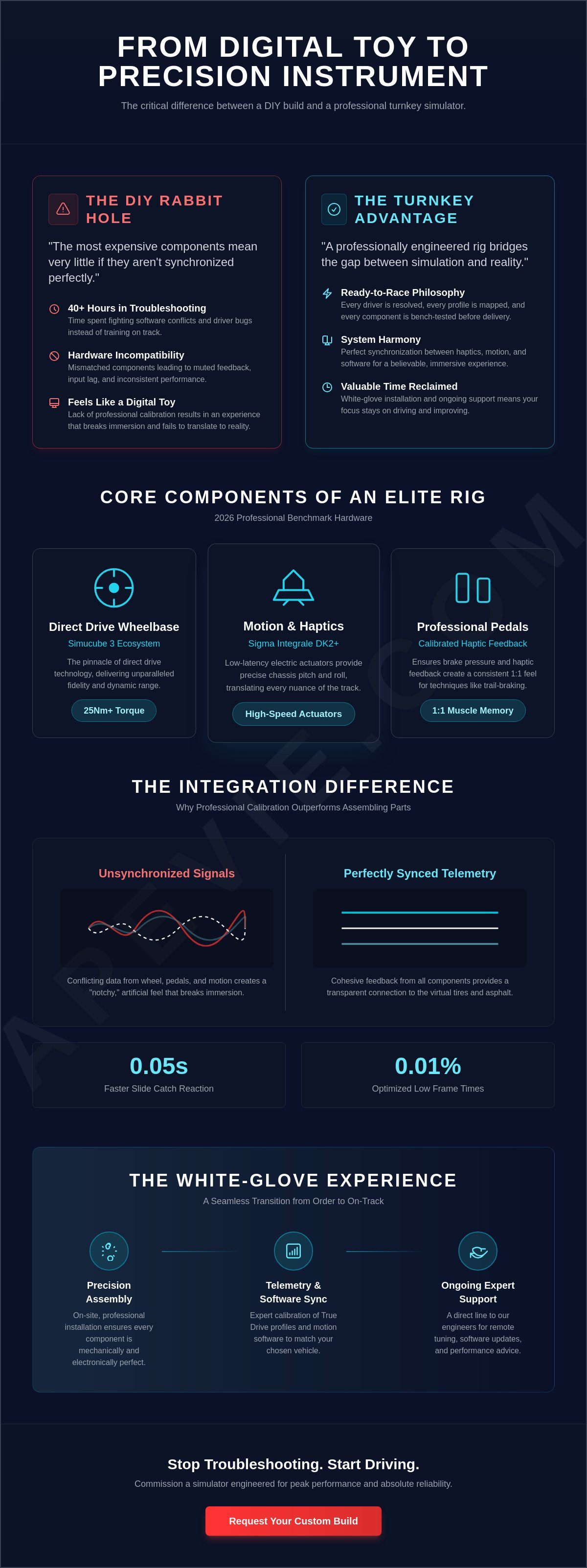
The "ready-to-race" philosophy is built for individuals who demand precision without the headache of assembly. We treat a simulator build like a race team treats a car. It's about system harmony. If the haptic feedback from your pedals doesn't match the slip angle reported by the software, your brain won't buy into the illusion. Professional setups ensure that the digital gap disappears through rigorous bench testing and software synchronization that most DIY builders simply don't have the tools to perform.
The Shift from Console Gaming to Professional Simulation
Consoles like the PlayStation 5 or Xbox Series X are closed ecosystems. They limit your refresh rates and hardware choices. Professional simulators rely exclusively on high-performance PC platforms to handle the complex physics calculations required by iRacing or Assetto Corsa Competizione. While brands like Fanatec offer entry-level direct drive options, professional builds utilize the Simucube 2 or Simucube 3 ecosystem. These industrial-grade motors provide the fidelity needed to feel the front tires scrubbing in a high-speed corner, a sensation that consumer-grade gear often mutes through filtered signals.
Why Professional Drivers Choose Bespoke Turnkey Solutions
Professional drivers and high-net-worth collectors value their time above all else. Building a rig from a parts list often leads to a "DIY rabbit hole" where software bugs and calibration issues consume dozens of hours. A bespoke solution ensures that the brake pressure required for a 1:1 trail-braking feel in a Porsche 911 GT3 stays consistent every single session. Companies like CXC Simulations have set the bar for this philosophy, ensuring that custom turnkey sim racing builds california clients receive a museum-quality centerpiece that complements a high-end home or office while providing world-class training capabilities.
The Core Components of an Elite Professional Rig
An elite simulator is defined by the quality of its feedback loops. When commissioning custom turnkey sim racing builds california experts often start with the foundation: the wheelbase. While mid-tier options like Moza or Fanatec are popular for hobbyists, professional-grade systems for 2026 utilize the Simucube 3 ecosystem. These units deliver 25Nm of torque as a baseline benchmark. This high torque isn't about making the steering impossible to turn; it's about dynamic range. A 25Nm motor can replicate the subtle vibrations of a flat-spotted tire even while you're fighting 12Nm of cornering force in a high-downforce prototype car.
Direct Drive Technology: The Heart of the Build
The Simucube 3 motor architecture represents the current pinnacle of direct drive technology. It achieves superior fidelity through an industry-leading slew rate, which measures how quickly the motor can change its torque output. High slew rates coupled with near-zero torque ripple ensure that the driver feels every crack in the pavement at Sebring without any artificial "notchy" sensations. Simucube 3 provides the most transparent connection to the virtual tires by eliminating the mechanical noise found in lesser systems. This clarity allows a driver to catch a slide 0.05 seconds faster than they could on consumer-grade hardware.
Motion and Haptics: Beyond Simple Vibration
True immersion requires more than a vibrating seat. We utilize the Sigma Integrale DK2+ as a cornerstone of the Apevie motion philosophy because of its incredibly low latency. Unlike traditional hydraulic or pneumatic actuators that can feel "mushy," the DK2+ uses high-speed electric actuators to provide precise chassis pitch and roll. This system communicates the "seat-of-the-pants" feel necessary for detecting traction loss. By providing 2 inches of rapid travel, it simulates the weight transfer of a GT3 car under heavy braking, ensuring your inner ear and your eyes receive the same data simultaneously.
Premium Controls: Pedals and Steering Wheels
Consistency on the track is a direct result of braking precision. We specify Heusinkveld Ultimate+ pedals for their sophisticated load cell and hydraulic damping systems. These pedals don't measure how far you push them; they measure the pressure you apply, mirroring the physics of a real racing brake system. For a deeper dive into why this matters, see The Ultimate Guide to Sim Racing Pedals.
The steering wheel is your primary interface, and brands like Gomez Sim Industries (GSI) and Cube Controls lead the market in ergonomic superiority. The GSI Formula Pro Elite offers a rigid, zero-flex carbon fiber chassis, while the Cube Controls F-Core provides a lighter, more tactile experience. High-quality shifters and encoders provide a distinct mechanical click that builds muscle memory. This ensures you never miss a shift or fumble for a brake bias dial during a night stint at Le Mans. If you're ready to specify your own elite setup, our consultants can help you design a tailored simulation environment that fits your specific racing goals.
System Integration vs. Parts Lists: Why Calibration Matters
The most common question we hear from enthusiasts is whether they can simply replicate a professional build by ordering the same parts list found in our specifications. While anyone can purchase a Simucube motor or Heusinkveld pedals, the integration of these high-performance components requires a level of calibration that goes far beyond basic assembly. In the world of custom turnkey sim racing builds california clients often discover that raw hardware represents only 40% of the total performance. The remaining 60% is found in software synchronization and electrical management that prevents a premium rig from feeling like a disjointed collection of gaming peripherals.
One critical technical challenge involves managing Electromagnetic Interference (EMI). High-torque direct drive motors generate significant electrical noise that can cause "ghost inputs" on steering wheels or cause pedals to flicker in the telemetry. We solve this through industrial-grade shielding and dedicated grounding paths, a step frequently overlooked in DIY projects. Without this level of engineering, your investment can suffer from random disconnects or erratic behavior during a competitive session, breaking the immersion you worked so hard to create.
The Engineering of Force Feedback Tuning
Tuning the True Drive software for a Simucube wheelbase is a precise art that requires real-world automotive knowledge. A GT3 car requires a heavier steering rack feel with specific damping and friction settings to simulate the power steering systems found in a Mercedes-AMG GT3. Conversely, a Formula 1 profile needs high-frequency response and minimal damping to replicate the twitchy, direct nature of a high-downforce single-seater. We provide custom-mapped profiles for every car class, ensuring the force feedback never "clips" or loses detail during high-load cornering. This telemetry-driven approach ensures that the haptic feedback through the seat and wheel matches the visual data on your screen perfectly.
Chassis Rigidity and Ergonomics
A motion system is only as effective as the frame it is bolted to. An aluminum profile rig is the only foundation capable of handling the violent forces of a Sigma Integrale system without introducing unwanted flex. If the chassis flexes, you lose the subtle haptic details that communicate when your rear tires are beginning to lose grip. We utilize heavy-duty 160mm x 40mm profiles to ensure absolute rigidity under maximum braking and cornering loads.
Ergonomics are equally vital for long-distance consistency. Replicating the 1:1 seating position of a specific car class ensures that your muscle memory translates directly to the real track. This includes the exact distance to the monitors to ensure a mathematically correct Field of View (FOV) and the precise angle of the pedal tray for optimal trail-braking control. Finally, we treat cable management as a design priority. By hiding every wire within the profile channels, we turn a complex machine into a piece of functional art that complements a modern home or office environment.
Specifying Your Custom Build: A Decision Framework
Choosing the right components for a professional simulator is a process of elimination that begins with your primary racing goals. You aren't just buying parts; you're designing a training environment that must remain relevant through 2026 and beyond. While we serve a global clientele, our custom turnkey sim racing builds california workshop focuses on a five step framework to ensure every component serves a specific purpose. This methodical approach prevents the "feature creep" that often leads to cluttered, unoptimized setups.
- Step 1: Identify your primary discipline. A Formula 1 enthusiast requires a reclined seating position and a high-ratio steering rack, while a GT3 racer needs an upright seat and a larger diameter wheel for better leverage.
- Step 2: Determine your visual preference. You must choose between the absolute immersion of VR or the spatial awareness and long-session comfort of triple monitors.
- Step 3: Choose your haptic depth. Decide if you need a static chassis with seat haptics or a full 4-degree-of-freedom (4DOF) motion platform.
- Step 4: Select a control interface. Match your steering wheel and pedal set to the real-world cars you intend to drive to ensure muscle memory carries over to the track.
- Step 5: Plan the physical footprint. Ensure your space can handle the 10 foot by 6 foot area required for motion clearance and the dedicated 20-amp circuit needed for high-torque motors.
Visuals: Triples vs. Ultrawide vs. VR
By 2026, the debate between VR and monitors has shifted toward specialized use cases. VR offers unparalleled depth perception, but it lacks the peripheral vision and physical button visibility required for complex endurance racing. Most professional drivers prefer triple monitor setups because they provide a consistent 180-degree field of view. To drive triple 4K displays at a stable 144Hz, we specify workstations equipped with Nvidia RTX 5090 GPUs. This ensures that your frame timing remains perfectly synchronized with your wheelbase, eliminating the micro-stutter that can ruin a qualifying lap.
Selecting the Right Motion System
The choice between motion systems often comes down to the frequency of feedback you desire. A 2DOF system focuses on seat-of-the-pants feel, whereas a 4DOF system adds heave and yaw, allowing you to feel the car's rear end stepping out. The Sigma Integrale DK2+ is our preferred choice for drivers who prioritize "tactile" feedback, such as the specific vibration of a serrated curb. If space is at a premium, D-BOX haptics provide a more compact solution that excels at high-frequency vibrations without the large footprint of traditional actuators. If you're ready to start your project, you can schedule a consultation to specify your build with our engineering team.
Apevie’s National White-Glove Installation & Support
The journey from a conceptual design to a world-class racing environment requires more than a shipping label. While some providers of custom turnkey sim racing builds california focus solely on the assembly of parts, we view the installation as a critical engineering phase. Our process ensures that the high-fidelity signals from your Simucube 3 wheelbase and Sigma Integrale actuators are perfectly synchronized with your PC telemetry output before the first lap is ever driven. We don't just deliver hardware; we deliver a calibrated instrument ready for professional-level training.
The Consultation and Design Phase
Every project begins with a deep-dive consultation to align hardware with your specific motorsport objectives. Whether you're training for a season in the IMSA WeatherTech SportsCar Championship or building a dedicated Formula 1 simulator, we tailor every component choice to match. We utilize CAD-based planning to visualize the rig footprint within your space, ensuring the aesthetics of the aluminum profile and carbon fiber accents complement your room's interior. As authorized distributors for Simucube and GSI, we provide direct access to factory-fresh components, ensuring your build features the latest 2026 revisions and firmware updates.
On-Site Setup and Driver Coaching
The final 10% of a build often determines its long-term success. Our white-glove service includes on-site calibration where our engineers fine-tune the pedal face angles and steering wheel height to your exact physical dimensions. We don't leave until the brake pressure required for 100% force in the simulator matches the physical resistance of your real-world race car. This phase includes a comprehensive orientation on the software ecosystem, covering everything from iRacing telemetry logging to motion profile adjustments. This ensures zero downtime for the client and an immediate transition into productive training.
Post-installation, we provide ongoing remote support to ensure your system remains at the cutting edge. As software like Assetto Corsa 2 or new iRacing builds release, our team manages the updates and recalibrates your motion profiles to maintain consistency. This commitment to technical excellence is why Apevie is the preferred choice for national turnkey builds. If you're ready to transition from a gaming setup to a professional-grade simulation environment, contact Apevie Simulator today for a design consultation or to browse our curated selection of professional hardware.
Master the Digital Asphalt in 2026
A professional racing simulator is more than a luxury; it's a precision instrument designed to eliminate the digital gap between software and reality. We've explored how the synergy of Simucube 3 motors and Sigma Integrale motion systems creates a platform where every curb strike and tire scrub is felt with absolute clarity. Building an elite rig requires solving complex engineering challenges like EMI shielding and telemetry synchronization that DIY projects often miss. While enthusiasts frequently search for custom turnkey sim racing builds california, the gold standard in simulation is a national, white-glove service that prioritizes bespoke engineering for professional motorsport training.
As an authorized Simucube and GSI dealer, we ensure your components are factory-certified and tuned to your specific driving style. Our national white-glove installation service handles the technical heavy lifting, from room CAD planning to final on-site haptic calibration. Don't settle for a collection of parts when you can have a race-ready cockpit engineered for consistency. Schedule your professional sim build consultation with Apevie Simulators and start training with the precision your racing career demands. We'll see you on the podium.
Frequently Asked Questions
How much space do I need for a full motion turnkey simulator?
A full motion simulator requires a dedicated footprint of approximately 10 feet by 7 feet to operate safely. This area accounts for the 160mm aluminum profile chassis and the necessary clearance for the actuators to achieve maximum pitch and roll. While static rigs can fit in an 8 foot by 5 foot space, motion platforms need this extra buffer to prevent the rig from contacting walls or furniture during violent heave maneuvers.
Can I use a custom turnkey sim rig with a PlayStation or Xbox?
Professional custom turnkey sim racing builds california specialists exclusively utilize PC platforms because high-end hardware from Simucube or Sigma Integrale lacks console-compatible security chips. Consoles are designed for consumer "plug-and-play" gear and cannot process the complex telemetry data required to drive professional motion actuators. A PC is the only platform that allows for the deep software integration necessary to synchronize haptics and high-fidelity visuals.
What is the difference between a load cell and a hydraulic pedal?
Load cell pedals measure the force applied through an electronic strain gauge, while hydraulic pedals use fluid pressure to replicate a real automotive master cylinder. Load cells are excellent for building consistent muscle memory through pressure rather than travel. However, hydraulic systems provide a superior "bleed" feel, allowing a driver to modulate the brakes more naturally during the final phase of trail-braking into a slow corner.
How long does the custom build and installation process take?
The timeline for a bespoke build typically ranges from 6 to 10 weeks from the initial design consultation to the on-site white-glove installation. This duration accounts for the procurement of premium components, the assembly of the rigid frame, and the rigorous 48-hour bench testing we perform. We ensure that every driver conflict is resolved and every motion profile is calibrated before the system arrives at your door.
Do I need a special electrical circuit for a high-end motion rig?
High-end motion rigs require a dedicated 20-amp electrical circuit to handle the peak power draws of the actuators and the direct drive wheelbase. A standard 15-amp household circuit might trip when a 25Nm motor and a 4-actuator motion system engage simultaneously during a heavy impact or high-G cornering. We recommend planning your electrical layout during the CAD design phase to ensure consistent performance without interruptions.
Why is a PC-based system better than a console for sim racing?
PC-based systems offer superior physics processing and support for high-refresh-rate displays exceeding 144Hz. Unlike consoles, PCs allow for deep telemetry integration with professional analysis tools like MoTeC, which is essential for driver development. This open architecture is the only way to synchronize multiple high-end USB devices, such as hydraulic pedals and haptic seats, into a single, cohesive racing instrument that mirrors reality.
What kind of maintenance does a professional sim rig require?
Maintenance for a professional rig is minimal but essential, primarily involving a monthly check of the T-nut bolts on the aluminum profile to ensure everything remains rigid. You should also keep the PC fan filters clear of dust and perform quarterly software updates for your motion profiles. High-end electric actuators are generally sealed units that don't require internal lubrication for several years of heavy professional use.
Is VR better than triple monitors for professional race training?
Triple monitors are generally considered better for professional race training due to their 180-degree field of view and reduced eye strain during long sessions. While VR provides 1:1 depth perception, it often leads to heat buildup and physical fatigue that can degrade training quality. Most drivers find that triple 32-inch or 42-inch displays offer the best balance of immersion and the spatial awareness needed for competitive racing.