
The Heusinkveld Buying Guide 2026: Choosing the Ultimate Sim Racing Hardware
You might think a faster direct-drive motor is the key to finding those missing tenths, but your lap times are actually won or lost in the braking zone. When you step into the world of heusinkveld hardware, you're moving away from gaming peripherals and toward professional motorsport instrumentation. It's frustrating to deal with inconsistent trail braking or a pedal plate that flexes just when you need maximum pressure. You want a setup that rewards muscle memory rather than forcing you to guess where the bite point is every single lap.
This guide will help you master the technical nuances of Heusinkveld’s professional-grade pedals and shifters so you can build a simulator that truly mirrors the physics of a real race car. We'll break down the differences between the Sim Pedals Sprint and the heavy-duty Ultimate+ series, explore the latest 2026 software updates like the April release of DisplayDash, and explain how these components integrate into a high-end aluminum profile rig. Whether you're a seasoned esports pro or a driver looking for the ultimate training tool, understanding these mechanical foundations is the first step toward total consistency.
Key Takeaways
- Learn why high-quality steel construction and custom elastomers are the foundation of Heusinkveld’s engineering philosophy.
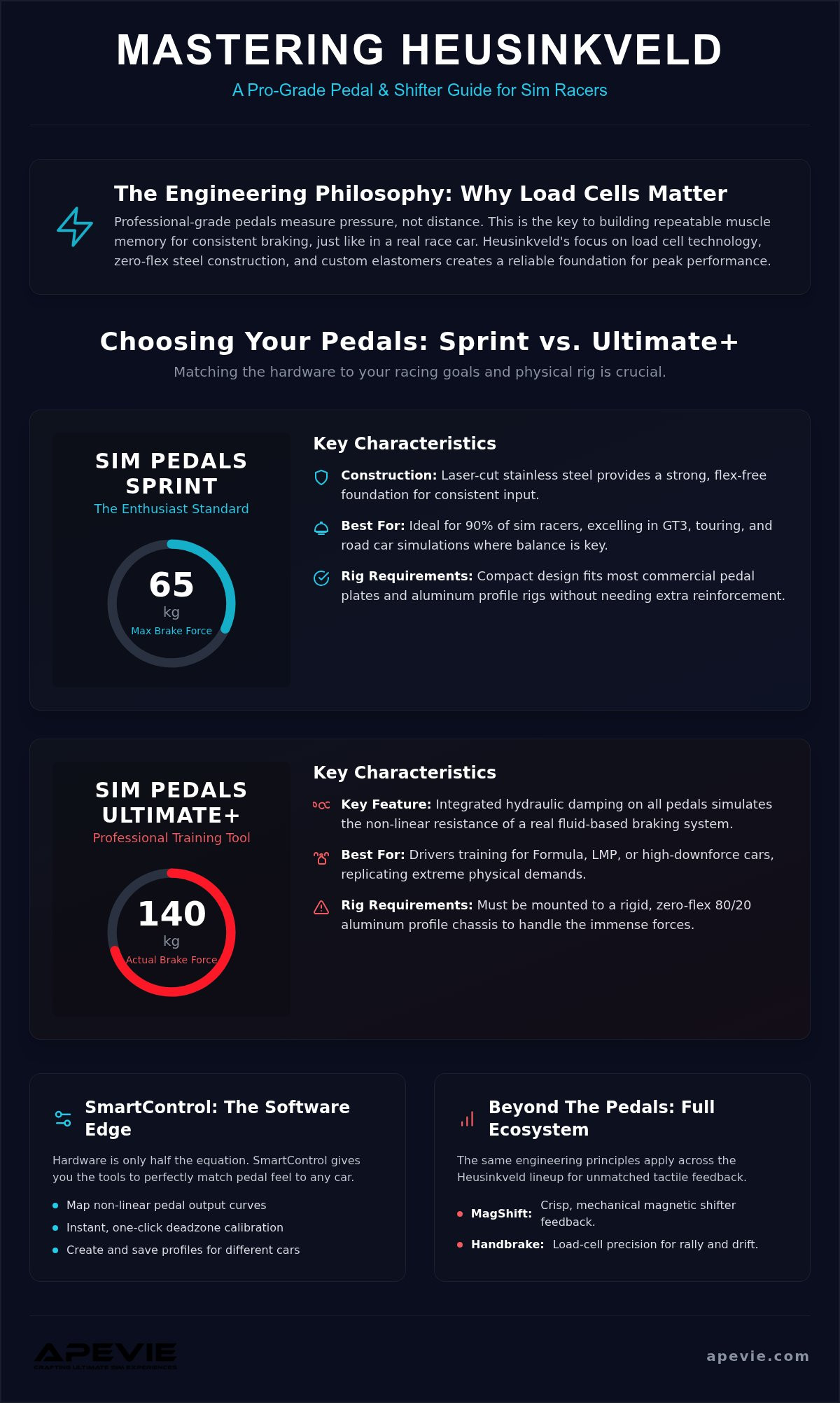
- Determine whether the 65kg force of the Sim Pedals Sprint or the 140kg hydraulic damping of the Ultimate+ fits your driving style.
- Explore how the MagShift and load-cell handbrake provide the tactile mechanical feedback necessary for drift and rally disciplines.
- Understand the rig requirements for high-end gear, specifically why 80/20 aluminum profiles are essential for handling extreme braking forces.
- See how Apevie’s white-glove service simplifies the transition to heusinkveld hardware through professional mounting and software calibration.
The Heusinkveld Engineering Philosophy: Why Load Cells Matter
Most entry-level pedals rely on potentiometers, which measure the distance the pedal travels. In a real race car, your braking force depends on how hard you press the pedal, not how far it moves. This is why heusinkveld designs focus exclusively on load cell technology. By measuring pressure, these sensors allow your brain to build reliable muscle memory. It's much easier for your body to replicate a specific leg pressure than a specific distance, especially during high-stress trail braking. Professional sim racers prioritize this pressure-based input because it mimics the hydraulic resistance found in a GT3 or Formula cockpit.
Precision Engineering and Materials
Durability isn't just about lasting for years; it's about maintaining the same feel every time you sit in the rig. Heusinkveld pedals use laser-cut stainless steel for a zero-flex construction. If your pedal plate or arms bend under pressure, the sensor data becomes muddy and inconsistent. To ensure a smooth, maintenance-free life, these units feature self-lubricating bushings at the pivot points. The tactile feedback comes from custom-designed elastomers that simulate the compression of a hydraulic system. Unlike cheap rubber components, these industrial-grade materials don't degrade or change density during a long endurance stint, ensuring your 100th lap feels identical to your first.
SmartControl: The Software Edge
Hardware is only half the battle. The SmartControl software allows you to map non-linear output curves to match specific car classes. You can configure a soft, progressive bite for a GT3 car where ABS is active, or a rock-hard, immediate response for a high-downforce Formula car. This level of customization ensures the hardware adapts to the sim, not the other way around. SmartControl allows you to eliminate deadzones instantly with a single click, providing a crisp response the moment your foot touches the plate.
At Apevie Simulator, we often see drivers struggle with calibration when moving to professional gear. We integrate these components into our turnkey builds to ensure the software curves are optimized for titles like iRacing and ACC from day one. Proper calibration means you aren't fighting the hardware; you're just driving the car. You get a simulator that mirrors the physics of a real race car through precise pressure mapping rather than generic travel measurements.
Choosing Your Pedals: Heusinkveld Sim Pedals Sprint vs. Ultimate+
Deciding between the two flagship offerings from heusinkveld is less about finding the "better" product and more about matching hardware to your physical rig and racing goals. The Sim Pedals Sprint and Ultimate+ series represent two distinct tiers of resistance and tactile feedback. One serves as a refined tool for daily competition, while the other functions as a high-fidelity training instrument for professional drivers. Understanding the mechanical ceiling of each set is vital before you bolt them to your chassis.
Heusinkveld Sim Pedals Sprint: The Enthusiast Standard
The Sprint set is the ideal choice for roughly 90% of home sim racers. With a maximum brake force of 65kg, it provides more than enough resistance to develop precise trail-braking habits without requiring an industrial-grade cockpit. Its compact design is a major advantage for those with space constraints. These pedals fit onto almost any commercial pedal plate, including the Fanatec GT Cockpit or standard aluminum extrusion rigs. For drivers primarily competing in GT3 or road car classes where pedal travel is still a factor in the driving feel, the Sprints offer a perfect balance of performance and accessibility.
Heusinkveld Sim Pedals Ultimate+: Professional Motorsport Training
The Ultimate+ pedals are designed for those who want to replicate the extreme physical demands of a Formula car or a high-downforce prototype. Utilizing a 200kg load cell to achieve 140kg of actual brake force, these pedals require a rock-solid foundation to prevent flex. The standout feature here is the integrated hydraulic damping on all three pedals. This system simulates the non-linear resistance of a real hydraulic circuit, particularly in the clutch, where you can feel the distinct "bite point" as the diaphragm spring collapses. For a deeper dive into the physics of these systems, check out The Ultimate Guide to Sim Racing Pedals.
- Sim Pedals Sprint: Best for GT3/Road racing, standard sim rigs, and drivers who prefer a slightly lighter pedal feel.
- Sim Pedals Ultimate+: Best for Formula/Prototype training, professional aluminum rigs, and drivers seeking the highest level of hydraulic realism.
The choice ultimately depends on whether your rig can handle the massive 140kg load of the Ultimate+ line. If you aren't sure if your current setup is rigid enough, our team can help you select the right hardware for your specific simulator goals.
Beyond the Pedals: MagShift, Handbrakes, and Ecosystem
While the pedals provide the mechanical foundation, the rest of the heusinkveld ecosystem ensures that every tactile interaction in your cockpit feels like a genuine motorsport component. Moving beyond the feet, the shifter and handbrake are where you find the mechanical soul of a rally or touring car build. These peripherals aren't just buttons; they're high-fidelity instruments designed to withstand the violent inputs of competitive racing. At Apevie Simulator, we view these components as the final pieces of a sensory loop that connects the driver to the physics of the simulation.
MagShift and MagShift Mini: Tactile Gear Changes
The MagShift line replaces traditional mechanical springs with a sophisticated magnetic tension system. This design offers a significant advantage in longevity because magnets don't fatigue or snap like steel springs. The primary benefit for the driver is the crisp, heavy clunk of a sequential gearbox. You can adjust the peak shift force between 4.5 and 11 kg, allowing you to simulate anything from a light GT shifter to the heavy throw of a vintage touring car. For compact rigs or formula-style setups, the MagShift Mini provides the same magnetic precision in a smaller footprint. We frequently pair these shifters with Gomez Sim Industries steering wheels to create a cohesive, high-performance interface for our turnkey builds.
The Sim Handbrake: Precision Drifting
Rally and drift disciplines require a level of finesse that a simple on/off switch cannot provide. The Heusinkveld Sim Handbrake uses a 20kg load cell to measure the exact force of your pull, ensuring that your rear-tire lockup is consistent every time you initiate a slide. This pressure-based system is essential for rally consistency because it allows you to modulate the brake just like a hydraulic unit found in a WRC car. The hardware is highly versatile, featuring mounting options for both horizontal and vertical orientations to match your preferred cockpit layout. You can also swap the elastomers to adjust the resistance, mimicking different master cylinder setups depending on your preference.
Integrated Telemetry and Professional Setup
The ecosystem is rounded out by the DisplayDash, which received a significant software update in April 2026. This unit brings critical telemetry into your visual field, reducing the need to look away from the apex during high-speed maneuvers. Integrating these components requires more than just bolting them down; it involves precise ergonomic placement and software calibration. We specialize in mounting these peripherals onto aluminum extrusion sim rigs to ensure zero flex during heavy shifting or handbrake pulls. By choosing a turnkey solution, you ensure that your shifter, handbrake, and dash work in perfect harmony with your Simucube 3 or Fanatec wheel base.
The Buyer’s Checklist: Matching Hardware to Your Sim Rig
Investing in a set of heusinkveld pedals without considering your cockpit's structural integrity is a recipe for frustration. If you've chosen the Ultimate+ series, you're looking at 140kg of peak brake force. Most entry-level or mid-range cockpits are made of thin-walled steel tubing or stamped metal plates. These will flex significantly under heavy braking. Flex doesn't just feel bad; it eats your consistency by absorbing the force that the load cell is supposed to measure. You end up with a "mushy" feeling that makes trail braking almost impossible to master.
Evaluating Your Foundation
Before you install high-end hardware, perform a simple flex test on your current setup. Have someone watch your pedal plate while you simulate an emergency stop. If you see even a few millimeters of movement, you're losing fidelity. A professional build requires a rigid, direct connection between the pedal mount and the seat frame to ensure every ounce of pressure goes into the sensor. For this reason, we exclusively recommend aluminum extrusion sim rigs for any build featuring Heusinkveld hardware. These systems provide the modularity and stiffness needed to handle professional-grade forces without a hint of movement. For a deeper look at chassis selection, read The Ultimate Sim Rig Guide.
Ergonomics and Positioning
Your physical comfort is a performance metric. If your pedals are too high or the angle is too steep, you'll develop ankle fatigue or lower back pain during endurance stints. Heusinkveld pedals offer extensive physical adjustment, but they need a versatile mounting surface to shine. You should be able to adjust the pedal face angle so it's perpendicular to your leg at full compression. This ergonomic alignment is why aluminum profile rigs are superior; they allow for infinite micro-adjustments in height and pitch that fixed-plate rigs simply can't match.
Connectivity and Cable Management
Modern heusinkveld units use a dedicated controller box that aggregates the signals from your pedals, shifter, and handbrake into a single USB connection. This simplifies your PC setup but requires careful cable routing. In a high-vibration environment, such as a rig equipped with a Sigma Integrale DK2 motion system, cables can rub against sharp metal edges or work themselves loose. We suggest using braided sleeving and secure mounting points to protect these connections. When integrating with a Simucube 2 Pro or similar direct-drive base, keep the data cables away from power bricks to prevent electromagnetic interference. If you're building a professional-grade simulator and want to ensure zero flex and perfect cable management, you can consult with our experts to design a turnkey solution.
Professional Integration: Why Source Heusinkveld via Apevie?
Building a world-class simulator requires more than just a credit card and a shipping address. When you invest in heusinkveld hardware, you're buying into a professional ecosystem that demands precise integration to reach its full potential. Sourcing your gear through an authorized US dealer like Apevie Simulator ensures you aren't just getting a box on your doorstep; you're gaining a technical partner. We handle the logistical heavy lifting, from verifying component compatibility to managing domestic warranty claims, so you can focus on your lap times rather than troubleshooting hardware.
The Turnkey Advantage
Many enthusiasts underestimate the compatibility headache that comes with mixing high-end brands. A Simucube 3 wheel base, a GSI Formula Pro Elite wheel, and Heusinkveld Ultimate+ pedals are all top-tier components, but they need to be perfectly synchronized within a rigid chassis. Our turnkey racing simulator packages eliminate the guesswork. We provide expert consultation to match your hardware to your primary racing discipline. If you're an iRacing specialist, we'll configure your pedal curves for maximum ABS efficiency. If you prefer the GT3 focus of ACC, we'll tune the hydraulic damping to match the brake feel of a modern GT car. Our process is designed to build your dream high-performance sim rig without the trial-and-error often found in DIY setups.
Expert Support and Calibration
Physical mounting is only the first step. The real magic happens during the software calibration phase. Our white-glove installation service includes custom force-curve tuning tailored to your physical strength and driving style. We don't just set a generic profile; we work with you to find the exact pressure threshold where your muscle memory becomes most effective. Whether you need remote assistance or on-site support, our team ensures your heusinkveld peripherals are optimized for years of daily use. We understand the nuances of the SmartControl software and how to eliminate deadzones without sacrificing the natural feel of the load cell.
Transitioning to professional-grade hardware is a significant step in your sim racing career. You deserve a setup that is as reliable as it is fast. You can Shop the full Heusinkveld collection at Apevie to begin your custom build today. Our team is ready to help you integrate these components into a high-performance rig that mirrors the physics of a real race car through professional consultation and white-glove service.
Building Your Professional Racing Foundation
Selecting the right pedals is the most significant decision you'll make for your simulator's consistency. Whether you choose the accessible Sim Pedals Sprint or the professional-grade Ultimate+ series, heusinkveld engineering provides the mechanical fidelity needed to master the most challenging braking zones. Remember that your hardware is only as good as its foundation; ensuring a rigid, zero-flex rig is essential to capturing the full resolution of these high-force sensors.
At Apevie Simulator, we specialize in bridging the gap between high-end components and a perfectly calibrated driving experience. As an authorized Heusinkveld USA dealer, we offer more than just parts. We provide expert white-glove installation and custom tuning for high-performance turnkey builds, ensuring your software curves and physical ergonomics are optimized for your preferred racing title.
Upgrade your simulator with the Heusinkveld Collection at Apevie and start finding those missing tenths with confidence. We're here to help you build a simulator that doesn't just feel like a game, but like a genuine extension of your racing career.
Frequently Asked Questions
Are Heusinkveld Sprints good for iRacing?
Yes, they are highly optimized for iRacing. The load cell technology provides the precision needed for the simulator's complex tire model. You can use the SmartControl software to map a specific curve that matches the GT3 or Formula cars in the service. This ensures your trail braking is consistent across every lap. Most iRacing pros use these pedals to build the muscle memory required for top-split competition.
Do I need a special rig for Heusinkveld Ultimate+ pedals?
You definitely need a rigid rig. Specifically, an 80/20 aluminum extrusion sim rig is the only way to utilize the full 140kg of brake force. Entry-level cockpits will flex under these loads. This flex absorbs the energy meant for the sensor, which makes your braking feel inconsistent. If you're investing in the Ultimate+ line, ensure your pedal plate is reinforced to handle professional-grade pressure.
How do Heusinkveld pedals compare to Fanatec V3s?
These pedals represent a move from consumer electronics to professional motorsport hardware. While Fanatec V3s are excellent for starting out, heusinkveld units offer superior adjustability and industrial durability. The stainless steel construction eliminates the play found in mass-produced pedals. You get much more granular control over the pedal's throw, height, and resistance, making them a more precise tool for serious endurance racing.
Can I use Heusinkveld pedals on a console like PS5 or Xbox?
No, these pedals are designed exclusively for PC use on Windows 10 or newer systems. They connect directly via USB and rely on the SmartControl software for their advanced calibration features. While some third-party drive hubs exist to bridge the gap to consoles, they often compromise the signal resolution. We recommend using these components only within a dedicated PC-based simulator environment for the best performance.
What is the difference between a load cell and a potentiometer?
A load cell measures the force you apply with your leg, whereas a potentiometer only tracks how far the pedal moves. Real racing cars rely on hydraulic pressure, so a load cell is far more realistic. It allows you to modulate your braking based on pressure rather than position. This is the key to achieving lap time consistency through reliable muscle memory in high-pressure racing scenarios.
How often do Heusinkveld pedals need maintenance?
They are built for long-term, maintenance-free operation. The use of self-lubricating bushings and industrial-grade stainless steel means you won't need to apply grease or oil. We suggest a periodic check of the mounting bolts to ensure everything remains tight during high-vibration sessions. Keeping the elastomers free of dust will ensure the sensors provide a clean signal for years of daily competitive use.
Is the Heusinkveld Handbrake worth it for rally sim racing?
It is a vital upgrade for any serious rally or drift enthusiast. Unlike basic handbrakes that act as a simple button, the heusinkveld handbrake uses a 20kg load cell for analog control. This allows you to partially lock the rear wheels to rotate the car with extreme precision. It is built to withstand the aggressive pulls required in titles like Dirt Rally 2.0 or WRC.
What software is used to calibrate Heusinkveld pedals?
You will use the SmartControl and SmartControl Live software packages. These tools allow for deep customization of deadzones and force curves without requiring physical adjustments to the hardware. You can create different profiles for various car classes, such as a stiff pedal for Formula cars or a softer feel for street cars. The software also handles the latest 2026 telemetry updates for integrated dash displays.